

Introduction: Why a Well-Designed Wardrobe Matters
A wardrobe is one of the most important elements of bedroom interior design. It provides a dedicated place for clothing, footwear, accessories, and personal belongings while influencing how organised, spacious, and comfortable a bedroom feels.
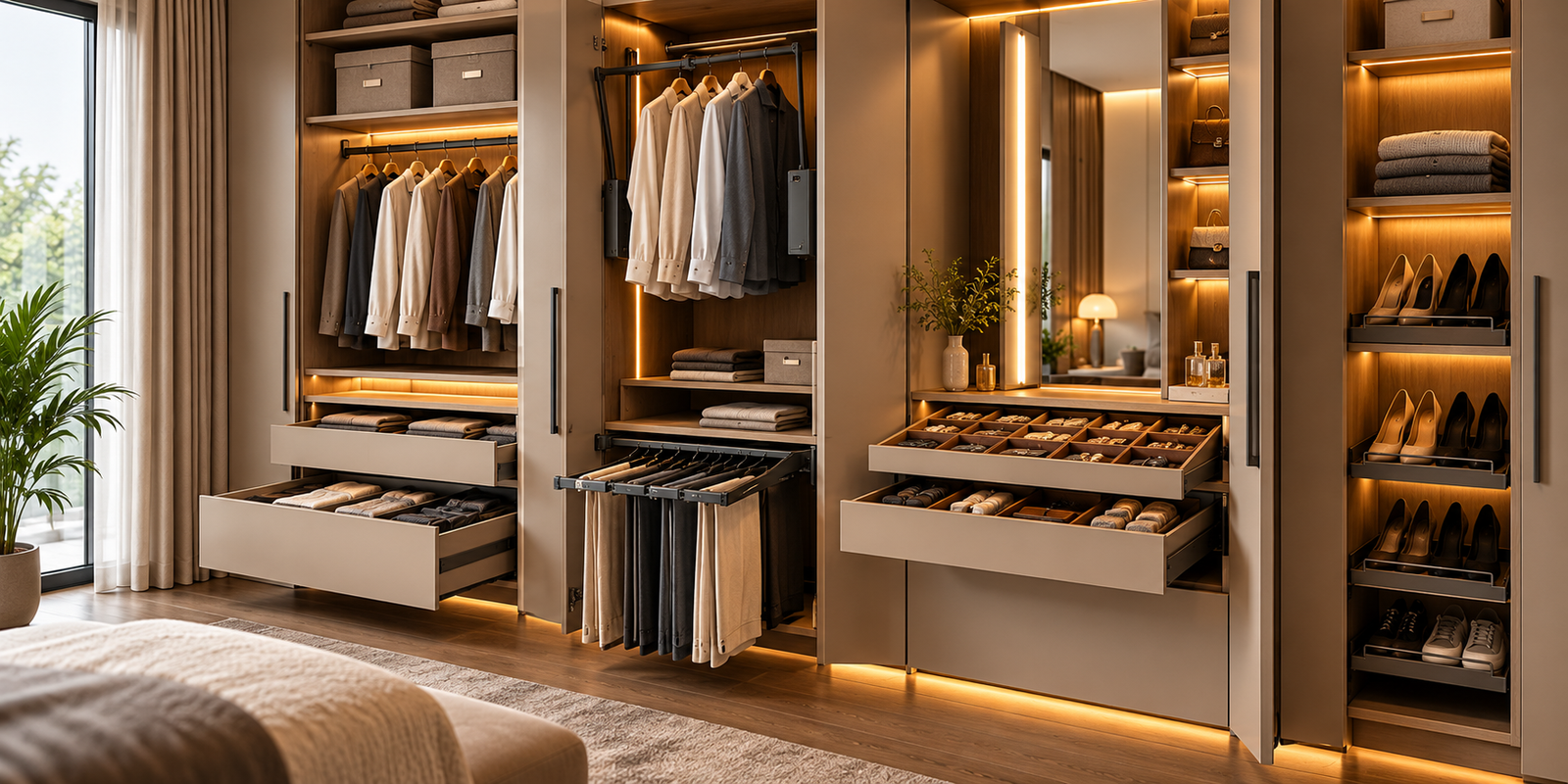
Modern wardrobe design has evolved beyond conventional cupboards with shelves and hanging rods. Today’s wardrobes can incorporate specialised drawers, pull-out organisers, adjustable shelving, integrated lighting, and space-saving mechanisms that make everyday routines easier.
However, an attractive wardrobe is not necessarily a functional one. Poorly planned hanging space, inaccessible shelves, inadequate drawer depth, and unsuitable materials can create difficulties that become apparent only after the wardrobe is in regular use.
A thoughtfully designed signature wardrobe considers the user’s clothing habits, available floor space, storage requirements, room dimensions, and preferred interior style. It balances appearance with practical features so that frequently used items remain accessible and less frequently used belongings can be stored efficiently.
Whether you are designing a wardrobe for a new home or upgrading an existing bedroom, understanding the fundamentals of wardrobe planning can help you make informed decisions and avoid common design mistakes.
1. Start With Your Storage Requirements
Before selecting a wardrobe finish or deciding how many shutters it should have, evaluate what needs to be stored inside it.
Different households have different requirements. Someone with a large collection of formal clothing may need more hanging space, while another person may require additional shelves for folded garments, footwear, handbags, or seasonal items.
Begin by dividing your belongings into categories:
- Everyday clothing and frequently worn outfits
- Shirts, dresses, jackets, suits, and other hanging garments
- Trousers, jeans, and folded clothing
- Undergarments, socks, and smaller accessories
- Jewellery, watches, belts, and ties
- Footwear and handbags
- Seasonal clothing, blankets, and travel accessories
- Laundry waiting to be washed
This exercise helps establish the approximate amount of hanging, drawer, shelf, and specialised storage required.
It is also important to consider how your storage needs may change. A wardrobe designed for a growing family, for example, may benefit from adjustable shelves and flexible compartments rather than fixed divisions for every category.
Avoid planning solely around the number of shelves or shutters. The objective is to create storage that matches the volume and type of belongings you actually own.
2. Choose a Wardrobe Layout That Suits Your Bedroom
The wardrobe layout should complement the room rather than dominate it. Doorways, windows, bedside tables, dressing areas, and movement paths must all be considered before finalising its dimensions.
Hinged-Door Wardrobes
Hinged wardrobes use conventional doors attached to cabinet sides. They provide a full opening to the internal compartments and can be convenient when users need to access multiple sections simultaneously.
However, the doors require adequate clearance when opened. In compact bedrooms, they may interfere with nearby furniture or restrict movement.
Hinged wardrobes are suitable when there is enough space in front of the cabinet and when easy access to the full internal arrangement is a priority.
Sliding-Door Wardrobes
Sliding wardrobes use panels that move along tracks rather than swinging outward. They can be useful in bedrooms where floor space is limited.
Because only part of the wardrobe is accessible at a time, internal organisation becomes especially important. Drawers, hanging sections, and shelves should be arranged so that frequently used belongings are not inconveniently positioned behind another panel.
The track system should be selected according to the panel weight, installation requirements, and expected usage.
Walk-In Wardrobes
A walk-in wardrobe creates a dedicated storage area that may include hanging sections, drawers, shelves, mirrors, and seating.
Its effectiveness depends on circulation space and the arrangement of the storage units. A poorly planned walk-in can consume valuable floor area without providing significantly better access than a well-designed conventional wardrobe.
Plan the internal walkway, lighting, ventilation, and door access before deciding how much storage to incorporate.
Floor-to-Ceiling Wardrobes
Floor-to-ceiling wardrobes use the available vertical height to increase storage capacity and create a continuous architectural appearance.
The upper compartments are useful for luggage, blankets, and seasonal items, while frequently used clothing should remain within comfortable reach.
Where higher shelves require a step stool, provide a safe place to store it without obstructing the room.
The most appropriate layout depends on bedroom dimensions, ceiling height, circulation requirements, and how often each storage section will be used.
3. Plan the Internal Organisation Carefully
An effective wardrobe separates different types of belongings into logical zones. This reduces clutter and makes it easier to find items without disturbing the rest of the arrangement.
Hanging Zone
Hanging sections are useful for clothing that wrinkles easily or needs to retain its shape. Shirts, jackets, dresses, coats, and formal garments may require different hanging heights.
Measure longer garments before fixing the internal dimensions. A compartment designed only for shirts may not accommodate dresses or long coats comfortably.
Double hanging sections can increase capacity for shorter garments, provided the arrangement remains convenient for the user.
Drawer Zone
Drawers are suitable for folded clothing, undergarments, socks, and small personal items. Their usefulness depends on appropriate depth, smooth operation, and internal organisation.
Avoid making every drawer the same height when the stored items vary considerably. Shallow drawers are often more suitable for smaller belongings, while deeper drawers may be needed for bulkier clothing.
Shelving Zone
Shelves can accommodate folded garments, bags, storage boxes, and other personal belongings.
Adjustable shelving provides flexibility when storage needs change. Shelf spacing should reflect the size of the items stored, and heavier belongings should be placed on appropriately supported shelves.
Very deep shelves can make items at the back difficult to access. Consider how much usable space is available rather than focusing only on total cabinet depth.
Specialised Storage Zone
Items such as jewellery, belts, ties, trousers, and footwear often benefit from dedicated storage systems.
Specialised organisers can prevent smaller belongings from becoming mixed together, while pull-out mechanisms can improve access to areas that might otherwise be difficult to reach.
The ideal arrangement places everyday essentials in convenient positions and reserves less accessible compartments for items used occasionally.
4. Essential Signature Wardrobe Accessories for Better Organisation
Wardrobe accessories help transform a basic cabinet into a storage system designed around everyday routines. Their value lies in improving accessibility, protecting belongings, and making better use of the available space.
Before selecting an accessory, verify its dimensions, load capacity, installation requirements, maintenance needs, and compatibility with the wardrobe’s internal layout.
4.1 Soft-Close Drawers: Quiet and Organised Everyday Storage
Soft-close drawers are designed with mechanisms that slow the drawer during its final closing movement. This helps reduce sudden impacts, noise, and repeated slamming during everyday use.
Inside a wardrobe, they are particularly useful for storing folded garments, undergarments, socks, accessories, and other personal items.
A well-planned drawer arrangement separates belongings into categories. For example, one drawer can hold everyday essentials, another can accommodate sleepwear, and a separate compartment can be reserved for smaller accessories.
Internal dividers can improve organisation further by preventing items from shifting or becoming mixed together.
When selecting soft-close drawers, pay attention to runner quality, extension length, load rating, and the stability of the drawer when fully extended. The closing mechanism should be compatible with the drawer’s weight and dimensions.
It is also important to consider accessibility. Drawers positioned too low may be uncomfortable to use frequently, while drawers placed too high may make their contents difficult to see.
Keep the runners free from excessive dust and avoid forcing drawers beyond their intended capacity. Properly selected drawer systems can improve both the convenience and longevity of wardrobe storage.
4.2 Pull-Down Hanging Unit: Making High Storage More Accessible
A pull-down hanging unit is a wardrobe accessory designed to bring a high-mounted hanging rail down to a more accessible position.
It can be particularly useful in tall wardrobes where the upper hanging area would otherwise be difficult to reach. Clothing can be stored higher without requiring users to stretch repeatedly or rely on a step stool for everyday access.
The mechanism is generally suited to garments such as shirts, jackets, and other items that can be hung on a rail. The exact capacity depends on the selected product and its installation.
Before choosing a pull-down unit, measure the internal wardrobe height and confirm that sufficient clearance remains for the rail and hanging garments to move safely.
Check the recommended load, operating mechanism, mounting requirements, and space required for the handle or pull-down movement. Installation into an unsuitable cabinet structure can affect performance and safety.
A pull-down hanging unit is most effective when used for garments that need frequent access. Seasonal items that are rarely used may be better stored in fixed upper shelves.
4.3 Trouser Pull-Out: Keeping Trousers Neat and Accessible
A trouser pull-out provides a dedicated sliding arrangement for trousers, pants, and selected formal garments.
Instead of stacking trousers on shelves or placing them on individual hangers along a crowded rail, the pull-out keeps them organised in a designated section. This can make it easier to identify different garments and select an outfit without disturbing nearby clothing.
Depending on the design, the accessory may feature multiple hanging bars or individual supports. Some systems allow trousers to be viewed from above, while others use a pull-out frame that extends from the wardrobe.
When planning the installation, consider the available cabinet width, internal depth, rail spacing, and clearance from adjacent drawers or doors.
The number of trousers stored should remain within the manufacturer’s recommended capacity. Overcrowding can make garments difficult to remove and may increase friction between the stored items.
Position the trouser pull-out near the main hanging section if it forms part of a coordinated clothing zone. This arrangement can simplify dressing routines by keeping trousers close to shirts, jackets, and other complementary garments.
4.4 Tie and Belt Organizer: Preventing Small Accessories From Becoming Cluttered
Ties and belts are often difficult to organise using conventional shelves because they can become tangled, folded, or hidden beneath other belongings.
A dedicated tie and belt organiser provides separate positions for these accessories, allowing users to view their options and retrieve individual items more easily.
Depending on the design, organisers may be mounted within the wardrobe, attached to a sliding frame, or integrated into a specialised accessory compartment.
The most suitable arrangement depends on the number of ties and belts, the available cabinet width, and the user’s preferred dressing routine.
Place the organiser at a convenient height and ensure it does not interfere with adjacent shutters or hanging garments.
For leather belts, avoid arrangements that force the material into tight bends for prolonged periods. Ties should also be stored in a way that does not unnecessarily crease or stretch their fabric.
A dedicated organiser can be especially helpful for people who regularly wear formal clothing, uniforms, or business attire. It provides a clear view of accessories while keeping them separate from folded garments.
4.5 Jewellery Tray: Dedicated Storage for Delicate Accessories
A jewellery tray creates an organised space for rings, earrings, necklaces, bracelets, watches, and other small personal accessories.
Without dedicated compartments, jewellery can become tangled or mixed together in larger drawers. A tray with divided sections makes individual items easier to locate and can reduce unnecessary handling.
Different types of jewellery require different storage arrangements. Rings and earrings benefit from appropriately sized compartments, while longer necklaces need enough space to avoid tangling.
Soft-lined inserts may help reduce surface contact and scratching, depending on the jewellery material and lining quality.
Before choosing a tray, consider its depth, the number of compartments, and whether the wardrobe drawer can accommodate it without restricting movement.
Keep valuable jewellery in secure storage and follow the care recommendations appropriate to each material. Some metals and gemstones require specific storage conditions, and a tray alone does not protect jewellery from every environmental risk.
For households with limited drawer space, a removable jewellery insert can offer flexibility. It can be taken out when cleaning or rearranging the wardrobe while keeping small items grouped together.
4.6 Shoe Rack: Organising Footwear Without Wasting Space
A dedicated shoe rack keeps footwear organised and prevents shoes from occupying bedroom floors or becoming mixed with clothing.
Wardrobe shoe storage can take several forms, including fixed shelves, adjustable racks, sliding frames, or angled display-style compartments.
The right arrangement depends on the types of footwear stored. Everyday shoes, sandals, formal footwear, boots, and larger sports shoes may require different shelf heights and depths.
Before designing the shoe section, estimate the number of pairs that need to be accommodated. Consider future requirements as well as current footwear, but avoid allocating excessive space to items that are rarely used.
Ventilation and cleanliness are important considerations. Shoes should be allowed to dry before being placed in an enclosed cabinet, particularly after exposure to rain or perspiration.
Use materials and finishes that can be cleaned easily, and consider a separate area for footwear that is frequently worn outdoors.
The shoe rack should also remain accessible without obstructing drawers or hanging sections. When planned correctly, it helps maintain a cleaner bedroom and makes daily outfit selection more convenient.
4.7 Laundry Basket: Separating Worn Clothing From Clean Garments
A built-in laundry basket creates a designated place for clothing that has been worn and needs washing.
It can help prevent laundry from accumulating on the floor, bed, or chair. Keeping worn clothing separate from clean garments also supports better wardrobe organisation.
Depending on the cabinet design, a laundry basket may be integrated into a pull-out drawer or fitted within a dedicated compartment. Removable baskets can be especially practical because they can be carried directly to the laundry area.
When planning this feature, consider its capacity, ventilation, accessibility, and ease of cleaning. The basket should be large enough for normal household use without occupying space needed for more frequently accessed clothing.
Ventilation is particularly important when storing damp or sweaty garments. Wet clothing should not be left in a closed wardrobe basket for extended periods, as trapped moisture can encourage unpleasant odours and microbial growth.
A removable, washable liner may make routine maintenance easier, depending on the basket design.
For shared wardrobes, consider whether separate laundry compartments would improve organisation. A well-designed laundry basket helps maintain a tidier bedroom while making the transition between wearing, storing, and washing clothes more systematic.
4.8 LED Sensor Lighting: Improving Visibility Inside the Wardrobe
LED sensor lighting can improve visibility inside wardrobes, especially in deep compartments, tall cabinets, and areas with limited natural light.
Sensor-controlled lights can switch on automatically when a wardrobe door opens or when movement is detected, depending on the selected system. This reduces the need to locate a separate switch whenever clothing or accessories are needed.
Lighting is particularly useful for identifying garment colours, locating smaller accessories, and viewing the contents of upper or lower compartments.
The placement should illuminate the storage area without creating distracting glare or strong shadows. Lights integrated into cabinet sides or suitable internal profiles may provide more even illumination than a single light positioned at the top.
Before installation, consider the sensor type, power source, wiring route, maintenance access, and the manufacturer’s recommendations for the selected fixture.
For battery-operated systems, check how batteries can be replaced. For wired systems, plan the electrical connections before cabinet fabrication and ensure that installation is completed safely.
LED lighting should complement the wardrobe’s overall design rather than substitute for adequate bedroom lighting.
When combined with clear internal organisation, sensor lighting makes it easier to find belongings and improves the usability of wardrobe compartments throughout the day.
5. Select Wardrobe Materials and Finishes Carefully
The wardrobe’s external appearance is influenced by the material, surface finish, hardware, and detailing. However, the internal construction is equally important because it determines how well the storage system performs over time.
Plywood and Engineered Boards
Wardrobe carcasses may be made using plywood or suitable engineered boards, depending on the intended application, construction quality, and budget.
Compare the board specifications, thickness, edge treatment, expected loading, and suitability for the bedroom environment. Moisture resistance varies by product and should not be assumed from a general material label alone.
Good fabrication and secure hardware installation are important regardless of the board selected.
Laminate Finishes
Laminates are available in a wide range of colours, patterns, and textures. They can suit contemporary, minimalist, traditional, and wood-inspired interiors.
Their practical performance depends on the specific product, installation quality, and care requirements. Edge finishing is particularly important because exposed or poorly sealed edges can become vulnerable to damage.
Acrylic and Glossy Finishes
Glossy finishes can create a sleek appearance and reflect light, which may help a smaller room feel brighter.
However, the visibility of fingerprints, dust, and scratches depends on the product and colour. Consider how frequently the wardrobe will be cleaned before selecting a high-gloss surface.
Matte and Textured Finishes
Matte surfaces create a softer, understated appearance, while textured finishes can add depth and visual interest.
Some textured surfaces may require more attention during cleaning, so request care instructions before making a final decision.
Glass and Mirror Panels
Glass or mirror panels can create visual openness and support dressing routines. They may be particularly useful in compact bedrooms where a separate full-length mirror would occupy additional space.
The panel’s safety characteristics, mounting system, thickness, and maintenance requirements should be appropriate for its intended use.
6. Coordinate the Wardrobe With the Bedroom Interior
A signature wardrobe should feel like part of the bedroom’s overall design rather than an isolated furniture element.
Consider the relationship between the wardrobe finish, bed upholstery, flooring, wall colours, curtains, bedside furniture, and lighting.
Wood-inspired finishes can introduce warmth, while neutral colours such as beige, grey, and off-white can create a restrained appearance. Dark finishes can provide contrast but may require careful lighting to prevent the room from feeling visually heavy.
The size and visual weight of the wardrobe also matter. Large uninterrupted panels can create a clean appearance, while carefully selected grooves, contrasting finishes, or mirror sections can introduce variation.
Handle selection influences both appearance and usability. Integrated profiles can produce a streamlined effect, while conventional handles may offer a more familiar grip.
Avoid using too many contrasting finishes in a small bedroom. A limited material palette often creates a more cohesive result.
The wardrobe should also leave enough room for bedside access, dressing, and circulation. A visually impressive cabinet that makes the bedroom difficult to move around in is unlikely to remain satisfying in daily use.
7. Plan Lighting, Ventilation, and Accessibility
A wardrobe is an enclosed storage environment, so practical conditions matter alongside appearance.
Lighting
Bedroom lighting should support general illumination, reading, dressing, and nighttime movement. Wardrobe sensor lights can provide additional visibility within enclosed compartments.
If mirrors are included, check that the lighting allows users to view clothing clearly without uncomfortable glare.
Ventilation and Moisture Management
Clothing should be stored in a dry environment. Damp garments, wet footwear, and poorly ventilated storage can contribute to unpleasant odours and moisture-related problems.
Avoid storing damp laundry inside a closed wardrobe for extended periods. Check for signs of wall moisture or water leakage before installing a large built-in cabinet against the affected surface.
Where the room has persistent humidity, address the underlying ventilation or moisture problem rather than relying solely on wardrobe materials.
Accessibility
Frequently used belongings should be stored at comfortable heights. Upper shelves are better suited to occasional-use items, while everyday clothing and accessories should be easy to reach.
Consider the needs of all intended users, including children, older adults, and people who may have difficulty bending or reaching overhead.
The most effective wardrobe design is one that remains convenient for the people who use it every day.
8. Common Wardrobe Design Mistakes to Avoid
Designing without an inventory: Guessing storage requirements can leave the wardrobe with too much space in one section and too little in another.
Insufficient hanging height: Long garments may become crumpled if the hanging compartment is too short.
Too many fixed shelves: Fixed divisions can limit flexibility when storage needs change. Adjustable shelves may be more practical in selected sections.
Poor drawer planning: Deep, undivided drawers can become cluttered, while shallow drawers may not accommodate bulkier belongings.
Ignoring door clearance: Hinged doors, sliding panels, drawers, and nearby furniture must be coordinated to avoid access problems.
Overlooking hardware quality: Drawer runners, hinges, pull-down mechanisms, and sliding tracks experience repeated use. Confirm load limits, warranty terms, and service availability.
Neglecting ventilation: Storing damp clothing or footwear in enclosed spaces can create odour and moisture issues.
Using unsuitable finishes: The chosen surface should match the expected level of use and the owner’s maintenance preferences.
Ignoring future flexibility: A wardrobe should accommodate changing clothing requirements, household needs, and storage habits where possible.
Forgetting installation access: Confirm wall conditions, skirting, electrical points, ceiling height, and the route through which large cabinet components will be moved into the room.
Reviewing these factors before manufacturing begins can reduce unnecessary modifications and improve long-term usability.
9. How to Budget for a Signature Wardrobe
The cost of a wardrobe depends on its dimensions, internal configuration, materials, finishes, hardware, and installation requirements.
A detailed budget should account for the cabinet carcass, shutters, handles or profiles, drawer systems, hanging rails, specialised accessories, mirror panels, internal lighting, and installation.
Additional costs may arise from wall preparation, electrical work, site adjustments, or changes to existing furniture and room fittings.
When comparing quotations, ensure that the specifications are consistent. Two wardrobes with similar external dimensions may differ considerably in internal storage, hardware quality, finish, and the number of specialised accessories included.
Request clarity on board specifications, finish types, hardware details, installation scope, warranty coverage, and after-sales support.
Prioritise features according to their practical value. For example, drawer organisation may be essential for one household, while additional hanging space or a pull-down unit may be more useful for another.
A higher accessory count does not automatically produce a better wardrobe. The objective is to invest in features that solve real storage problems and remain convenient to use.
10. A Checklist Before Finalising Your Wardrobe Design
Before approving the wardrobe drawings, review the following points:
- Measure the bedroom and verify wall, ceiling, and floor dimensions.
- Confirm the wardrobe’s position relative to windows, doors, beds, and bedside furniture.
- Make an inventory of clothing, footwear, jewellery, and accessories.
- Decide how much hanging, drawer, shelf, and specialised storage is required.
- Check the height and depth needed for long garments and larger belongings.
- Confirm the dimensions and load ratings of pull-out accessories.
- Review the operation of drawers, hinges, and sliding mechanisms.
- Choose materials and finishes according to durability and maintenance requirements.
- Plan sensor lighting and any required electrical connections.
- Ensure that ventilation and moisture concerns have been addressed.
- Obtain a detailed quotation and written warranty information.
- Review the final drawings and internal layout before fabrication.
- Inspect alignment, hardware movement, finish quality, and overall installation before handover.
This process helps ensure that the wardrobe is designed around real requirements rather than appearance alone.
Conclusion: A Better Wardrobe Begins With Better Planning
A well-designed signature wardrobe brings together organised storage, appropriate materials, thoughtful lighting, and practical accessories. Its success depends on how effectively it supports everyday dressing, protects belongings, and makes the most of the available bedroom space.
Features such as soft-close drawers, pull-down hanging units, trouser pull-outs, tie and belt organisers, jewellery trays, shoe racks, laundry baskets, and LED sensor lighting can improve convenience when they are chosen according to individual needs.
The most important decisions, however, begin before accessories are selected. Accurate measurements, a clear understanding of storage requirements, suitable material choices, and careful planning of internal compartments establish the foundation for a functional wardrobe.
For homeowners planning a new bedroom interior or renovating an existing space, a considered approach to wardrobe design can help create an environment that feels organised, comfortable, and visually cohesive.
At Ocel Metallo, exploring wardrobe design through these practical considerations offers a useful starting point for understanding how thoughtful interior planning can improve everyday living.
Frequently Asked Questions
1. What should I consider before designing a wardrobe?
Start with bedroom measurements, clothing inventory, storage requirements, door clearance, and the placement of nearby furniture. Then choose the internal arrangement, materials, finishes, and accessories.
2. Are sliding wardrobes better than hinged wardrobes?
Neither option is universally better. Sliding wardrobes can save swing clearance, while hinged wardrobes provide access to a wider opening. The appropriate choice depends on room dimensions, access requirements, and the selected hardware.
3. Which wardrobe accessories are most useful?
Soft-close drawers, hanging organisers, trouser pull-outs, jewellery trays, shoe racks, and sensor lighting can be useful. The right selection depends on the user’s belongings and daily routines.
4. How can I maximise storage in a small bedroom?
Use vertical storage where practical, organise internal compartments by function, consider sliding doors when swing clearance is limited, and prioritise accessible storage for frequently used belongings.
5. Is wardrobe lighting necessary?
It is not essential in every wardrobe, but sensor-controlled LED lighting can improve visibility in deep or enclosed compartments, particularly when the bedroom has limited natural light.
6. How can I prevent moisture problems inside a wardrobe?
Store only dry clothing and footwear, address room humidity or wall leaks, and avoid leaving damp laundry in enclosed compartments. Follow the manufacturer’s recommendations for cabinet care and ventilation.
7. How much should I spend on wardrobe accessories?
Set a budget based on the accessories that solve your most important storage problems. Compare specifications and installation requirements rather than selecting features solely for their appearance.