

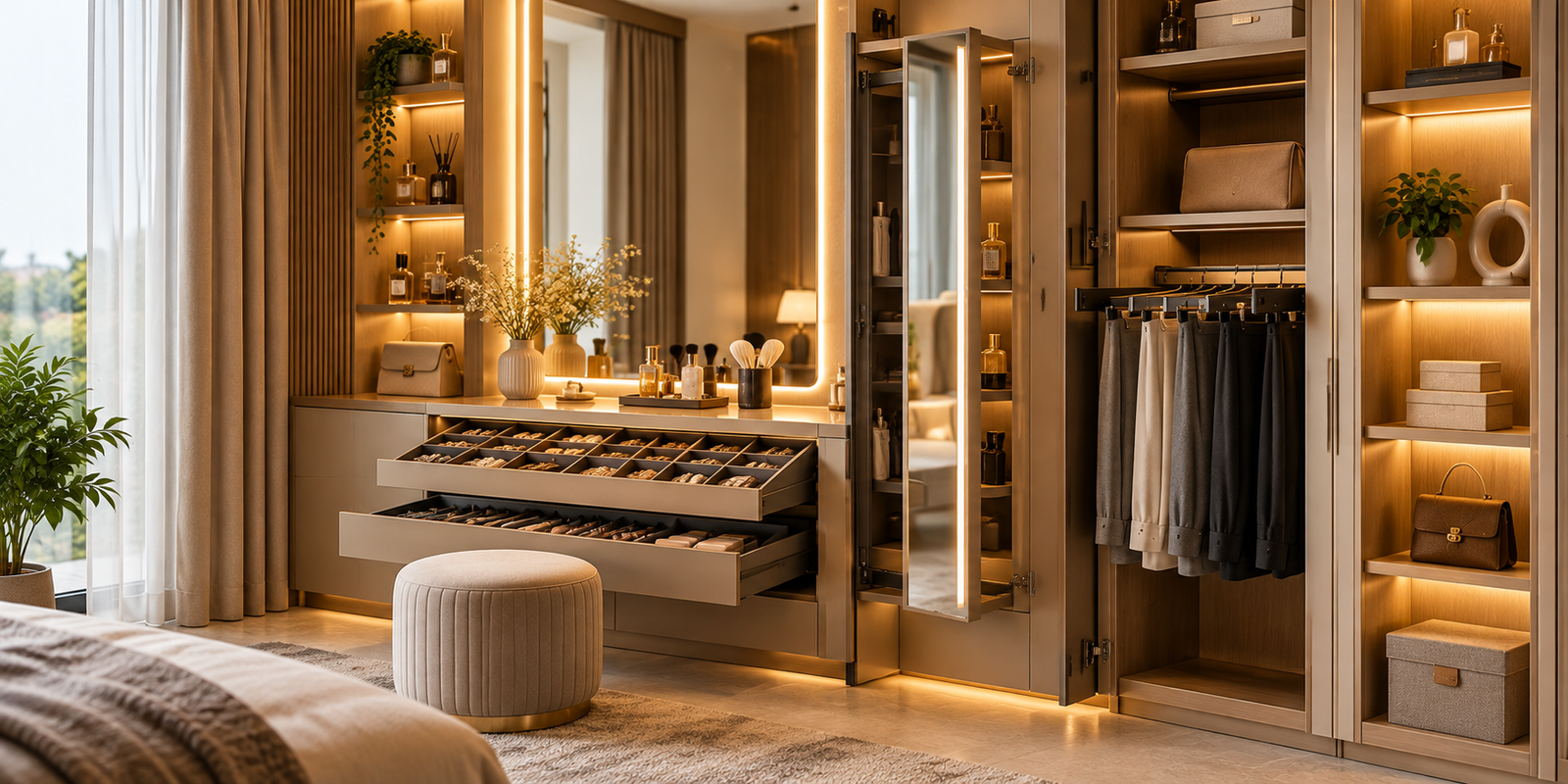
Introduction: Creating a Dressing Space That Combines Style and Functionality
A dressing area is more than a place to look in the mirror. It is a personal space where everyday grooming, skincare, jewellery selection, hairstyling, and preparation for work or special occasions take place. When designed thoughtfully, it can make daily routines more comfortable while adding visual appeal to the bedroom.
Modern dressing unit design combines mirrors, drawers, shelves, lighting, and specialised storage to create an organised environment for personal care. Depending on the available space, a dressing area may be integrated into a bedroom wardrobe, positioned beside a bed, incorporated into a walk-in wardrobe, or designed as a separate vanity unit.
However, a beautiful dressing table does not automatically provide a practical experience. Poor lighting can affect visibility, insufficient drawer organisation can lead to clutter, and an incorrectly positioned mirror can make everyday grooming inconvenient.
The key is to understand how the space will be used before deciding on its dimensions, materials, finishes, and accessories.
For homeowners planning a new bedroom interior or upgrading an existing dressing area, understanding these design considerations can help create a space that feels comfortable, organised, and visually cohesive.
1. Assess Your Dressing Needs Before Choosing a Design
The first step in designing a dressing unit is identifying the activities that will take place there.
Some people primarily need a mirror and a small surface for everyday grooming. Others require storage for skincare products, cosmetics, hair styling tools, watches, jewellery, perfumes, and personal accessories.
Make a list of the items you use regularly and consider how they should be stored.
For example, frequently used skincare products may need an easily accessible shelf, while jewellery benefits from a compartmentalised drawer. Hair styling tools require sufficient space and should be stored only after they have cooled according to their manufacturer’s instructions.
Consider the following questions before finalising the design:
- Will the dressing unit be used by one person or multiple household members?
- Do you need a full-length mirror for checking outfits?
- How much storage is required for jewellery, cosmetics, and accessories?
- Will the dressing area be used for hairstyling or other grooming activities?
- Is there sufficient room for a stool or chair?
- Should the unit be integrated with the wardrobe or designed separately?
- Does the room have enough natural light, or will artificial lighting be essential?
Answering these questions helps determine the appropriate combination of storage, mirrors, lighting, and countertop space.
A useful principle is to keep frequently used items within easy reach while reserving closed storage for belongings that do not need to remain visible.
2. Choose the Right Dressing Unit Layout
The available floor area and the relationship between the dressing unit and the rest of the bedroom will influence its design.
Wall-Mounted Dressing Units
Wall-mounted units can create a light, uncluttered appearance because the floor beneath them remains visible. They can be suitable for compact bedrooms where a bulky dressing table would occupy too much space.
Their installation requires suitable wall support, particularly when the unit includes drawers, mirrors, or other heavy components.
Before installation, check the wall construction, mounting system, and expected load. Electrical wiring and plumbing, where relevant, should also be considered before drilling or fixing the unit.
Freestanding Dressing Tables
A freestanding dressing table can provide a dedicated surface for grooming and personal care. It may include drawers, a mirror, and space for a stool.
This option offers flexibility in placement, but the furniture dimensions should be coordinated with nearby beds, wardrobes, doors, and walking paths.
Ensure that drawers can open fully and that the user can sit comfortably without obstructing circulation.
Integrated Wardrobe Dressing Units
A dressing unit integrated into a wardrobe can make efficient use of a continuous wall. It may combine a mirror, accessory drawers, open shelves, and concealed storage within one coordinated arrangement.
This approach is useful when the bedroom requires a unified interior design rather than several separate furniture elements.
However, the internal layout needs careful planning. Wardrobe doors, dressing drawers, and mirrors should not interfere with one another.
Corner Dressing Units
In some bedrooms, a corner can accommodate a compact dressing area that would not fit comfortably along a main wall.
The arrangement should provide enough room for a mirror, a small working surface, and comfortable movement. Lighting also requires attention because corners may receive less natural daylight.
The most suitable layout depends on the room dimensions, furniture arrangement, and daily grooming habits rather than appearance alone.
3. Mirror Placement and Size: Getting the Fundamentals Right
Mirrors are central to dressing unit design because they influence both functionality and the perceived openness of a room.
Full-Length Mirrors
A full-length mirror allows users to assess complete outfits, footwear, and overall appearance. It can be mounted on a wall, incorporated into a wardrobe door, or fitted within a specialised pull-out mechanism.
Before installation, consider the user’s height, viewing distance, available wall space, and the mirror’s position relative to the main light source.
The mirror should be positioned where the user can stand comfortably without obstructing a doorway or nearby furniture.
Tabletop and Wall Mirrors
Smaller mirrors are useful for skincare, makeup, shaving, and other detailed grooming activities.
A wall-mounted mirror can free up countertop space, while an adjustable tabletop mirror may provide greater flexibility for close-up tasks.
The selected mirror should be appropriate for the activities performed at the dressing unit. Magnifying mirrors, where used, are best treated as supplementary mirrors rather than replacements for a normal viewing surface.
Mirror Safety
The mirror’s mounting system, backing, and installation method should be suitable for its size and location.
Large mirrors should be installed securely, with particular attention to their weight and the strength of the supporting surface. Where appropriate, use safety-backed or safety-treated mirror products according to the application.
Avoid placing mirrors where their edges can be struck frequently by doors, drawers, or moving furniture.
4. Essential Dressing Unit Accessories for a Better Organised Space
Specialised accessories help make a dressing unit more functional by assigning dedicated spaces to different personal belongings. They can reduce countertop clutter, improve visibility, and make grooming routines more convenient.
The right selection depends on the available dimensions, the number of items stored, the required level of accessibility, and the maintenance needs of each accessory.
4.1 Soft-Close Drawers: Convenient Storage for Daily Grooming Essentials
Soft-close drawers use a mechanism that slows the drawer during its final closing movement, helping reduce impact and noise.
In a dressing unit, these drawers can accommodate skincare products, cosmetics, grooming tools, hair accessories, and other frequently used personal items.
Organising the contents by category makes the storage more useful. One drawer might hold everyday skincare products, another could contain cosmetics, and a separate section could accommodate hairbrushes and smaller grooming tools.
The drawer dimensions should reflect the items being stored. Shallow compartments can be useful for small products, while deeper drawers may accommodate larger bottles or containers.
Before choosing a drawer system, check the runner quality, extension length, load capacity, and compatibility with the cabinet construction. Bottles should remain upright, and the drawer should be easy to clean if products leak.
Soft-close functionality improves the closing experience, but it does not replace the need for good construction and appropriate loading.
Avoid storing heat-producing grooming appliances in a drawer while they are still hot. Keep electrical devices and their cables arranged according to the manufacturer’s instructions.
A properly planned drawer system can help maintain a tidy dressing surface while ensuring that frequently used essentials remain accessible.
4.2 Jewellery Organizer: Keeping Personal Accessories Sorted
Jewellery organisers provide dedicated compartments for rings, earrings, necklaces, bracelets, and other small accessories.
Without organised storage, delicate pieces can become tangled or scratched when placed together in a general drawer. Separate compartments make it easier to identify individual items and return them to their designated places after use.
The design should reflect the types of jewellery in the collection. Small compartments can hold rings and earrings, while longer sections may be needed for necklaces and bracelets.
Soft-lined inserts can help reduce surface contact, although the suitability of the lining depends on the jewellery materials and their care requirements.
For larger collections, consider organisers with removable trays or multiple levels. These can make better use of drawer height without requiring a separate cabinet for every accessory.
The organiser should fit securely within the drawer and allow the drawer to close without putting pressure on its contents.
Valuable jewellery should be stored with appropriate security measures. Some pieces may also require specific care to prevent tarnishing, abrasion, or damage from humidity.
A well-designed jewellery organiser is especially useful for people who wear accessories regularly because it simplifies selection and reduces the time spent searching for matching pieces.
4.3 Pull-Out Mirror: A Space-Saving Grooming Solution
A pull-out mirror is designed to slide out from a cabinet or dressing unit when required and return to its concealed position after use.
It can be particularly useful in compact bedrooms where a permanently exposed mirror would compete with other furniture or wall features.
Depending on the mechanism, the mirror may extend from a side compartment or another suitable section of the dressing unit. Some designs provide additional adjustment for viewing angle.
Before selecting this accessory, verify the available cabinet depth, mirror dimensions, extension clearance, and mounting requirements.
The mechanism should operate smoothly without colliding with nearby doors, drawers, or hanging garments. Its installation must also support the weight of the mirror safely.
Consider how the mirror will be used. A small pull-out mirror may be sufficient for close-up grooming, while checking complete outfits generally requires a larger viewing area.
Cleaning access is another important consideration. The mirror should be easy to wipe without requiring the entire unit to be dismantled.
A pull-out mirror is most valuable when it solves a genuine space constraint. If the room has sufficient wall space, a fixed mirror may be simpler and more economical.
4.4 Accessory Tray: Giving Small Essentials a Dedicated Place
An accessory tray provides organised storage for watches, rings, cufflinks, bracelets, earrings, and other small personal belongings.
Unlike a general drawer, a divided tray keeps different items separated and makes them easier to locate. It can also reduce the likelihood of accessories becoming mixed with skincare products, loose cables, or other everyday objects.
The compartments should match the sizes and shapes of the belongings being stored. Larger sections can accommodate watches, while smaller sections are suitable for rings or other compact items.
For watches and delicate accessories, a soft lining may help reduce scratching from contact with harder surfaces.
Accessory trays can be fixed within a drawer or designed as removable inserts. Removable trays make it easier to reorganise the dressing unit or clean the storage area.
When selecting a tray, check its internal dimensions, divider arrangement, material, and ease of maintenance. Avoid compartments so small that items become difficult to remove.
It is also helpful to keep frequently worn accessories near the front of the drawer while reserving less accessible sections for occasional-use items.
A well-planned accessory tray supports a simple daily routine: select the items needed, use them, and return them to the same organised location.
4.5 Rotatable Mirror Door: Combining Concealed Storage and Full-Length Viewing
A rotatable mirror door combines a mirror surface with a movable door mechanism, allowing the mirror to turn or pivot as part of a specialised storage arrangement.
Depending on the design, it can provide a full-length viewing surface while concealing shelving or selected personal belongings behind the mirror.
This arrangement can be useful in bedrooms where a separate mirror and storage cabinet would require additional wall space.
However, the mechanism needs careful planning. Its movement must remain clear of the bed, wardrobe shutters, dressing drawers, and surrounding furniture.
Check the door’s weight, pivot or hinge specifications, mounting structure, and the clearance required throughout its full movement. Large mirror panels should be installed using a suitable system designed for their weight and dimensions.
The internal storage should also remain practical. Frequently used items should not be placed where opening or rotating the mirror makes access inconvenient.
Because the accessory combines movement with a large reflective surface, installation quality and regular hardware inspection are especially important.
A rotatable mirror door works best when it is integrated into the room’s layout from the beginning rather than added after the surrounding furniture has been finalised.
4.6 Pull-Out Trouser Rack: Organising Clothing Near the Dressing Area
A pull-out trouser rack provides a dedicated arrangement for hanging and accessing trousers, pants, and selected garments.
Although it is commonly associated with wardrobes, it can be incorporated into an integrated dressing and wardrobe system to keep outfit components organised within the same area.
The rack typically uses a sliding frame or rail arrangement that extends from the cabinet. This allows users to view the stored garments without reaching deep into the wardrobe.
Before installation, confirm the internal width, cabinet depth, extension clearance, and the number of garments the rack is designed to support.
The storage arrangement should prevent trousers from becoming excessively crowded or folded over one another. Adequate spacing makes individual garments easier to remove and return.
Positioning the rack near the main hanging section can make outfit selection more convenient. Shirts, trousers, belts, and other coordinating accessories can then be stored in adjacent zones.
Check the manufacturer’s load rating and the quality of the sliding mechanism. The rack should move smoothly when loaded within its recommended capacity.
For smaller dressing areas, a compact pull-out rack may be more practical than allocating additional floor space to a separate clothes stand.
4.7 LED Sensor Lighting: Better Visibility for Everyday Grooming
LED sensor lighting can improve visibility inside dressing cabinets, drawers, and selected shelving areas.
Depending on the system, the light may activate when a door opens or when movement is detected. This can be useful when accessing personal belongings early in the morning or in the evening.
However, internal storage lighting and mirror lighting serve different purposes.
Internal lighting helps users locate products and accessories, while lighting around the mirror supports grooming activities that require a clear view of the face and appearance.
For mirror use, a suitably positioned, evenly distributed light source is generally more useful than a single bright light placed directly overhead. Excessive contrast and poorly positioned lights can create shadows that make grooming less comfortable.
Consider the colour rendering of the light, its brightness, the sensor’s operating behaviour, and the location of electrical connections.
Lighting that renders colours accurately can be particularly helpful when selecting cosmetics, coordinating clothing, or checking appearance.
For integrated systems, ensure that wiring, drivers, and other components remain accessible for maintenance. Battery-operated lights should allow convenient battery replacement.
LED sensor lighting should be planned before cabinet fabrication whenever possible, so that profiles, wiring routes, and mounting details can be incorporated neatly.
4.8 Open Display Shelves: Combining Accessibility With Personal Style
Open display shelves provide a place to arrange selected perfumes, decorative objects, small storage boxes, skincare products, and other personal items.
They introduce visual variety to a dressing area and can make frequently used products easy to reach without opening drawers or cabinet doors.
However, open shelving requires thoughtful organisation. Too many objects can make the space appear cluttered, while products exposed to dust, direct sunlight, or heat may require more frequent cleaning or may not be suitable for open storage.
Arrange items according to their size and frequency of use. Everyday essentials can occupy convenient positions, while decorative pieces and occasional-use belongings can be placed on less frequently accessed shelves.
Shelf depth and spacing should accommodate the actual products being stored. Heavy objects need appropriate structural support, and fragile items should not be positioned where they could be knocked over easily.
Integrated lighting can highlight selected objects, but it should be arranged to avoid glare and excessive heat exposure.
For a balanced appearance, combine open shelves with concealed storage. This allows the dressing area to display a few personal details while keeping smaller or less visually appealing belongings organised out of sight.
5. Plan Dressing Mirror Lighting for Accurate Visibility
Lighting is one of the most important elements of dressing unit design because it affects comfort, visibility, and the appearance of colours.
Natural daylight can provide useful illumination, but its intensity and direction change throughout the day. Artificial lighting should therefore be planned to support grooming even when daylight is limited.
Choose Suitable Light Placement
Lights positioned on both sides of a mirror can provide more even facial illumination than a single overhead source, depending on their height, distance, and diffusion.
A properly designed mirror light should minimise harsh shadows and uncomfortable glare. Diffused lighting can create a softer effect, while poorly positioned exposed light sources may be distracting.
Consider Colour Rendering
The colour rendering properties of a light source influence how accurately colours appear.
This is particularly relevant when selecting makeup, coordinating clothing, or assessing fabric colours. Choose lighting appropriate to the intended task rather than selecting fixtures solely for their decorative appearance.
Coordinate Lighting With the Interior
Warm lighting can complement wood finishes and neutral bedroom palettes, while other colour temperatures may suit different design preferences.
The important consideration is consistency between the mirror area, bedroom lighting, and nearby wardrobe lighting.
Avoid creating an excessively bright dressing area within an otherwise dim room, as the visual contrast can be uncomfortable.
Plan the switches, dimming controls where required, and electrical connections before the dressing unit is installed.
6. Select Materials and Finishes for Durability and Easy Maintenance
Dressing units are frequently used surfaces, so material selection should account for both appearance and practical upkeep.
Cabinet Construction
Plywood and suitable engineered boards are commonly used for dressing furniture, depending on the design, application, and construction requirements.
Evaluate the material specifications, thickness, edge treatment, expected loading, and suitability for the room’s conditions.
Drawers and shelves should be supported appropriately, particularly when they hold heavier products or accessories.
Laminate Finishes
Laminate finishes offer a wide range of colours, textures, and wood-inspired patterns.
They can work well in contemporary and traditional interiors, provided the surface and edge details are fabricated correctly.
Check the manufacturer’s cleaning recommendations and avoid assuming that every laminate has identical scratch or moisture resistance.
Acrylic and Glossy Surfaces
Glossy finishes can create a reflective, modern appearance and may help distribute light visually throughout a compact bedroom.
However, fingerprints and surface marks may be more noticeable on certain glossy finishes. Consider the level of maintenance you are comfortable with before choosing one.
Matte and Wood-Inspired Finishes
Matte surfaces offer a restrained appearance, while wood-inspired finishes can add warmth and complement bedroom furniture.
The final choice should coordinate with the bed, wardrobe, flooring, wall colours, and lighting.
Mirror and Glass Components
Mirror panels and glass shelves should be selected according to their intended application, weight, support requirements, and safety characteristics.
The supporting hardware and mounting details are as important as the visible finish.
7. Make a Small Dressing Area Feel More Spacious
A compact bedroom does not necessarily need a large dressing table to provide a useful grooming area.
The key is to prioritise functions and use the available space efficiently.
A wall-mounted dressing unit can free up floor space, while integrated drawers can keep small belongings organised without requiring additional cabinets.
A pull-out mirror may provide a useful alternative where a permanently exposed mirror would interfere with other furniture. Similarly, vertical storage can accommodate selected products without occupying a wide countertop.
Mirrors can create a greater sense of visual openness, particularly when positioned to reflect light from a window or a well-lit part of the room.
However, avoid placing mirrors where they reflect an unnecessarily cluttered area. The surrounding view influences the visual effect.
Keep the countertop relatively clear by assigning personal belongings to dedicated drawers, trays, or shelves. Store only frequently used products in the most accessible locations.
Most importantly, preserve sufficient clearance for sitting, standing, opening drawers, and moving around the bedroom.
A compact dressing unit should support comfortable grooming rather than forcing the user to work around a crowded arrangement.
8. Common Dressing Unit Design Mistakes to Avoid
Choosing a mirror without considering its use: A small decorative mirror may not be suitable for checking complete outfits or performing detailed grooming.
Poor lighting placement: Overhead lighting alone can create shadows. Plan the mirror lighting according to the activities performed.
Insufficient storage: Without a clear inventory, drawers and shelves may become overcrowded soon after installation.
Overusing open shelves: Excessive display storage can make the dressing area look cluttered and increase cleaning requirements.
Ignoring drawer dimensions: Compartments should accommodate the actual products, jewellery boxes, and accessories being stored.
Selecting accessories without checking clearance: Pull-out mirrors, rotating doors, and drawers need sufficient room to move without hitting nearby furniture.
Neglecting electrical planning: Sensor lighting, mirror lights, and powered grooming devices require appropriate electrical arrangements and safe installation.
Ignoring wall support: Wall-mounted units and large mirrors must be secured to suitable supporting structures.
Choosing finishes without considering maintenance: Highly reflective or textured surfaces may require different cleaning routines.
Overlooking comfort: The height of the countertop, position of the mirror, seating arrangement, and available legroom influence how convenient the dressing area feels.
Addressing these considerations before manufacturing begins can prevent expensive adjustments and create a more usable space.
9. How to Budget for an Elegant Dressing Unit
A dressing unit budget should reflect the complete installation rather than only the visible furniture.
Depending on the design, the cost may include the cabinet structure, countertop, mirror, drawers, hardware, specialised accessories, lighting, electrical work, seating, and installation.
Integrated designs may require additional coordination between the wardrobe, dressing table, mirror mechanism, and electrical components.
Request a detailed quotation that specifies the materials, finish, hardware, mirror dimensions, lighting arrangement, and installation inclusions.
Compare quotations using the same scope of work. A lower initial price may exclude specialised accessories or lighting that another quotation includes.
It is also useful to prioritise spending according to practical requirements. For someone with an extensive jewellery collection, an organiser may provide greater everyday value than elaborate display shelving. Someone who uses the dressing area mainly for full-length outfit checks may prioritise a suitable mirror and adequate lighting.
Specialised accessories should solve a real problem rather than increase the complexity of the installation unnecessarily.
A balanced budget combines durable construction, comfortable usability, and selected features that genuinely support daily routines.
10. A Checklist Before Finalising Your Dressing Unit
Before approving the final design, review these points:
- Measure the available wall and floor space accurately.
- Confirm the position of the bed, wardrobe, windows, doors, and nearby furniture.
- List the cosmetics, jewellery, accessories, and grooming products that need storage.
- Decide whether a full-length mirror, tabletop mirror, or pull-out mirror is most appropriate.
- Check the mirror’s size, viewing position, mounting method, and safety requirements.
- Confirm the dimensions and load capacity of drawers and pull-out accessories.
- Plan the arrangement of jewellery organisers and accessory trays.
- Choose finishes that suit the bedroom’s style and maintenance requirements.
- Plan mirror lighting and internal LED sensor lighting separately.
- Confirm the position of switches and electrical connections.
- Ensure that all moving mechanisms have adequate clearance.
- Request a detailed quotation and warranty information.
- Review the final drawings before fabrication begins.
- Inspect the mirror installation, drawer movement, lighting, and overall finish before handover.
This checklist helps ensure that the dressing unit is comfortable to use and suited to the homeowner’s everyday needs.
Conclusion: Thoughtful Design Makes Everyday Grooming Easier
An elegant dressing unit combines practical storage, suitable mirrors, effective lighting, durable materials, and a layout that supports everyday routines.
Accessories such as soft-close drawers, jewellery organisers, pull-out mirrors, accessory trays, rotatable mirror doors, pull-out trouser racks, LED sensor lighting, and open display shelves can improve convenience when selected according to the available space and the user’s requirements.
The most important decisions begin with understanding how the dressing area will be used. Accurate measurements, appropriate mirror placement, comfortable access, and carefully planned storage establish a strong foundation for the design.
For homeowners planning a new bedroom interior or upgrading an existing space, a well-designed dressing unit can provide a dedicated area for grooming while contributing to a more organised and visually cohesive bedroom.
At Ocel Metallo, exploring dressing unit design through these functional considerations offers a useful starting point for understanding how thoughtful interior planning can improve everyday comfort.
Frequently Asked Questions
1. What should I consider when designing a dressing unit?
Consider the available space, mirror size, lighting, storage requirements, seating comfort, electrical access, and how frequently different accessories will be used.
2. Which accessories are useful for a modern dressing unit?
Soft-close drawers, jewellery organisers, accessory trays, pull-out mirrors, rotatable mirror doors, trouser racks, LED sensor lighting, and open shelves can be useful depending on the layout and the user’s needs.
3. Is a pull-out mirror suitable for a small bedroom?
Yes. It can provide a mirror when required while remaining concealed when not in use. However, the cabinet must have sufficient space for the mechanism and its full movement.
4. What type of lighting is best for a dressing table?
Even, well-positioned lighting that minimises shadows is generally suitable for grooming. Side lighting or a properly designed mirror-lighting system can complement general bedroom illumination.
5. How can I organise jewellery in a dressing unit?
Use a compartmentalised organiser with sections appropriate for rings, earrings, necklaces, bracelets, and watches. Store valuable or delicate pieces according to their specific care and security requirements.
6. How can I make a dressing unit look less cluttered?
Use dedicated drawers and trays for small belongings, limit the number of objects displayed on open shelves, and keep frequently used products accessible without filling the countertop.
7. Should the dressing unit match the wardrobe?
It does not have to use exactly the same finish, but the materials, colours, handles, and lighting should complement the bedroom’s overall design.