

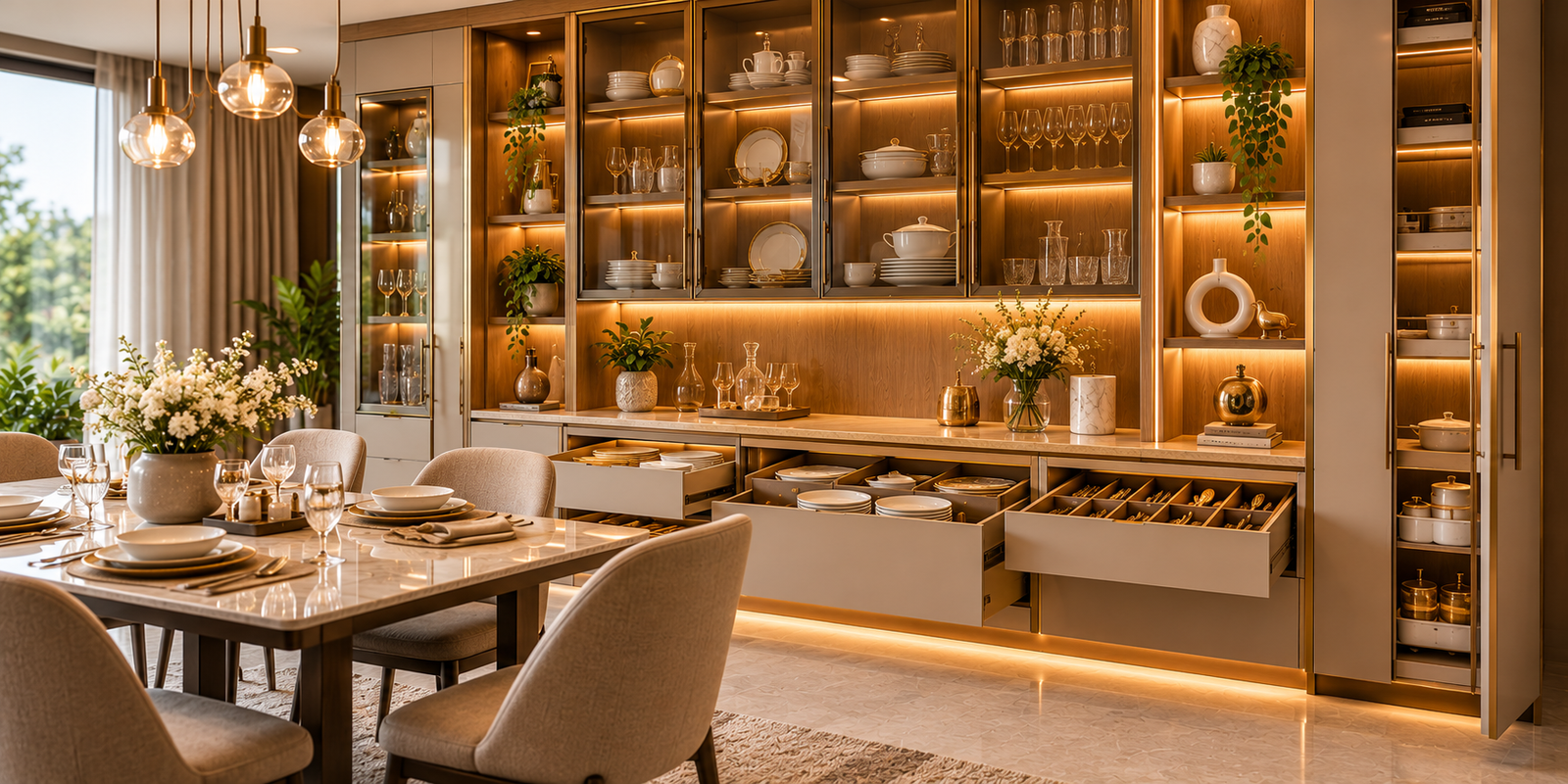
Introduction: Creating a Dining Space That Combines Storage and Style
The dining area is one of the most frequently used spaces in a home. It brings family members together for everyday meals, provides a setting for entertaining guests, and often becomes a place to display carefully selected tableware, glassware, and decorative objects.
A thoughtfully designed crockery unit helps organise these belongings while complementing the dining area’s overall interior. Depending on the home’s layout, it may take the form of a compact cabinet, a wall-mounted display unit, a built-in dining storage wall, or a full-height combination of closed cupboards and illuminated shelves.
Modern crockery unit design brings together practical storage, suitable materials, glass-fronted cabinets, organised drawers, and carefully planned lighting. It should make tableware easy to access without overcrowding the dining room or exposing delicate items to unnecessary damage.
However, a visually attractive display cabinet is not always practical. Insufficient shelf depth can make plates difficult to store, poorly planned glass cabinets can expose everything to dust, and inadequate lighting can create glare on reflective surfaces. A tall cabinet may also dominate a small dining area if its proportions are not considered carefully.
The key is to understand what needs to be stored, how often it will be used, and how the unit will relate to the dining table, kitchen, and surrounding furniture.
Whether you are planning a new dining room or upgrading an existing storage cabinet, these design considerations can help you create a space that is organised, visually balanced, and comfortable to use.
1. Assess Your Crockery and Dining Storage Needs
Before choosing a crockery unit, take an inventory of the items that need to be stored.
Different households have different requirements. Some may use a small collection of everyday plates, bowls, and glasses, while others need storage for formal dinnerware, serving dishes, wine glasses, decorative crockery, and special-occasion table settings.
Start by grouping items according to their purpose and frequency of use.
Typical categories include:
- Everyday plates, bowls, and cups
- Serving platters and large dishes
- Glasses, tumblers, and stemware
- Cutlery and serving utensils
- Tea and coffee accessories
- Special-occasion crockery
- Decorative ceramics and collectibles
- Table linen, napkins, and placemats
This inventory helps determine the number of shelves, drawer dimensions, cabinet heights, and types of organisers required.
Frequently used tableware should be easy to reach, particularly if the unit will be used every day. Special-occasion items can occupy higher or less accessible sections, provided they can still be retrieved safely.
Consider the weight and fragility of the items as well. Large ceramic serving dishes may require stronger shelves than lightweight decorative objects, while delicate glassware benefits from stable storage that minimises accidental contact.
Planning storage around actual belongings is generally more effective than selecting a cabinet based only on its external appearance.
2. Choose the Right Crockery Unit Layout
The ideal layout depends on the dining area’s dimensions, the position of the dining table, nearby doors, and the amount of storage required.
Wall-Mounted Crockery Units
Wall-mounted units can provide storage without occupying as much floor area as a freestanding cabinet.
They may be suitable for compact dining areas where maintaining an open floor plan is important.
However, the wall and fixing system must support the combined weight of the cabinet and its contents. Crockery can be heavy, especially when several stacks of plates and serving dishes are stored together.
Before installation, confirm the wall construction, mounting details, expected load, and access to electrical connections if lighting is integrated.
Floor-Mounted Crockery Cabinets
Floor-mounted cabinets can accommodate a larger quantity of crockery and may include drawers, enclosed cupboards, and display shelves.
Their dimensions should be coordinated with the dining table and available walking space. Cabinet doors and drawers must open without blocking chairs or restricting movement.
A floor-mounted unit may also provide a useful surface for serving dishes or selected decorative objects, depending on its design and the intended use.
Built-In Dining Storage
Built-in crockery units can integrate with a dining room’s wall panelling, kitchen cabinetry, or adjacent storage.
This approach creates a coordinated appearance and allows the internal layout to be tailored to the household’s collection.
However, the cabinet dimensions and electrical provisions should be finalised before fabrication. Allow for shelf adjustments, cleaning access, and future changes in crockery sizes.
Tall Crockery Units
Tall cabinets make use of vertical space and can provide separate zones for everyday dishes, serving pieces, glassware, and decorative objects.
Their proportions should suit the room. A tall, narrow unit may work well in a compact dining area, while a wider cabinet may provide a more balanced appearance on a large wall.
Heavy or frequently used items should generally be stored at comfortable heights. Upper shelves are better suited to lightweight or occasional-use items that can be retrieved safely.
The best layout balances storage capacity, accessibility, and visual proportion.
3. Plan Shelf Dimensions for Different Types of Crockery
A crockery unit should accommodate the actual sizes and shapes of the items being stored.
Standard plates, deep bowls, large serving platters, teacups, and decorative dishes do not all require the same shelf arrangement.
Plate and Bowl Storage
Stacked plates and bowls require sufficient vertical clearance for comfortable retrieval.
Shelves should be strong enough to support the combined weight of the stored crockery. Avoid stacking excessive quantities in a way that makes the bottom items difficult to remove.
If the collection includes several plate sizes, consider allocating separate sections for dinner plates, side plates, and bowls.
Serving Dishes and Platters
Large serving platters may need wider or taller compartments than everyday plates.
Measure the largest pieces before finalising shelf dimensions. A cabinet that accommodates standard dinner plates may not provide enough clearance for an oversized serving dish.
Adjustable shelving can help accommodate these differences.
Glassware
Glassware benefits from stable shelves with enough clearance to lift each item without striking the shelf above.
Stemmed glasses may need additional vertical space, while tumblers can be stored in more compact sections.
Consider how the cabinet doors open and whether the glassware can be retrieved without reaching awkwardly around other items.
Heavy Crockery
Stoneware, ceramic serving bowls, and large platters can place considerable weight on shelves.
Check the material, thickness, span, and support arrangement of each shelf. The cabinet should be designed for the expected load rather than relying on appearance alone.
4. Essential Crockery and Dining Display Accessories
The following eight accessories address the main storage and display requirements shown in your Crockery and Dining Accessories reference image.
Their usefulness depends on the size of the dining area, the household’s tableware collection, and the balance between everyday convenience and decorative display.
4.1 Soft-Close Drawers: Organising Cutlery and Dining Essentials
Soft-close drawers use a mechanism that slows the drawer during its final closing movement, reducing sudden impacts and noise.
In a dining storage unit, they can accommodate cutlery, serving spoons, table accessories, napkins, placemats, and other small dining essentials.
A dedicated drawer arrangement makes it easier to separate everyday items from special-occasion utensils. For example, one drawer may hold frequently used cutlery, while another can store serving tools or table accessories used during gatherings.
Internal dividers help keep utensils organised and prevent items from becoming mixed together.
The drawer dimensions should reflect the intended contents. Cutlery generally benefits from shallow compartments, while serving utensils and larger accessories may require more depth.
Before selecting the hardware, check the runner quality, extension length, load capacity, and compatibility with the cabinet.
Soft-close functionality improves convenience, but the drawers should not be overloaded. Heavy utensils should be stored in a drawer designed to support their weight, and spills should be cleaned promptly to protect the internal surfaces.
The objective is to keep frequently used dining items accessible while maintaining a clear countertop and an organised cabinet interior.
4.2 Glassware Storage: Protecting Glasses and Making Them Easy to Access
Glassware storage provides dedicated space for tumblers, drinking glasses, stemware, and other delicate items used during meals and entertaining.
Different types of glassware require different arrangements. Tall glasses need adequate vertical clearance, while stemmed glasses benefit from stable positioning that reduces the chance of accidental contact.
Measure the largest glasses before deciding the shelf spacing. A compartment that is too short can make glasses difficult to remove, while excessive unused space can reduce the cabinet’s overall storage efficiency.
Where appropriate, use stable organisers or suitable holders to keep delicate pieces separated.
Glass-fronted cabinets allow the collection to remain visible, but they also make dust and fingerprints more noticeable. Consider how often the cabinet will be cleaned and whether frequently used glassware would be better placed behind a more enclosed door arrangement.
Avoid overcrowding shelves. Glasses should be removable without striking neighbouring pieces or the cabinet frame.
For valuable or delicate glassware, choose a storage arrangement that minimises vibration and accidental impact.
A well-planned glassware section improves everyday accessibility while keeping the dining cabinet visually organised.
4.3 Crockery Storage: Keeping Plates, Bowls and Serving Dishes Organised
Dedicated crockery storage provides a place for plates, bowls, serving dishes, platters, and other tableware.
A useful arrangement separates everyday crockery from items reserved for special occasions. This allows frequently used plates to remain accessible while protecting less frequently used pieces from unnecessary handling.
Shelf spacing should reflect the sizes of the dishes. Dinner plates, side plates, bowls, and large serving platters may need separate compartments or adjustable shelf positions.
Consider how plates will be lifted from the stack. Extremely high stacks can be difficult to handle and increase the risk of dropping dishes.
The shelf structure must support the weight of the stored crockery. Check the material, thickness, span, and fixing method before installation.
For delicate or decorative pieces, consider using suitable dividers or protective organisers where needed.
Cabinet placement also matters. Everyday crockery should ideally be accessible from the dining area without requiring the user to walk around open doors or move other furniture.
If the unit is integrated with the kitchen or dining space, plan its contents according to where meals are prepared, served, and cleared.
The most effective crockery storage system combines logical organisation with easy access and appropriate support.
4.4 Open Display Shelves: Showcasing Decorative Tableware
Open display shelves provide space for selected ceramics, decorative plates, serving bowls, cookbooks, vases, and other objects that contribute to the dining area’s character.
They can break up a large cabinet wall and create a more open visual arrangement than a continuous run of closed cupboards.
The display should be planned carefully. Too many objects can make the shelves appear crowded, while a small selection of well-positioned items allows individual pieces to stand out.
Consider the weight and dimensions of each object before deciding the shelf spacing. Decorative plates may need display stands or secure supports, while larger serving bowls require enough depth to remain stable.
Open shelves collect dust and expose their contents to the surrounding environment. Items that are used for food service should be kept clean and stored appropriately.
Avoid positioning delicate objects where chair backs, passing people, or opening doors could knock them over.
If integrated lighting is used, ensure that it does not produce distracting glare on nearby glass doors or table surfaces.
Open display shelves are most effective when balanced with enclosed storage. This allows attractive pieces to remain visible while everyday clutter stays concealed.
4.5 Glass Shutter Cabinets: Displaying Crockery While Limiting Dust Exposure
Glass shutter cabinets combine enclosed storage with a clear view of the crockery inside.
They are useful when homeowners want to display selected tableware while providing a physical barrier against some dust and accidental contact.
The glass type, frame construction, hinge quality, and door dimensions should be considered before installation.
The cabinet must accommodate the weight of the stored items, and the shelves should be designed for their expected loads.
Glass doors require sufficient clearance to open without striking the dining table, chairs, or nearby furniture. In narrow dining areas, the door-opening direction and available circulation space are especially important.
The appearance of the cabinet depends on what is displayed inside. Coordinated stacks of plates, neatly arranged glassware, and a limited number of decorative pieces can create a calm visual effect.
However, glass doors make internal clutter more visible. If the collection contains many unrelated items, consider combining glass-fronted display sections with solid cabinet doors.
Cleaning requirements should also be considered. Glass panels can show fingerprints and smudges, particularly in households with children or frequent entertaining.
A glass shutter cabinet offers a practical balance between display and enclosed storage when its internal arrangement is planned thoughtfully.
4.6 Cutlery Organizer: Keeping Dining Utensils Separated and Accessible
A cutlery organiser provides designated compartments for spoons, forks, knives, serving utensils, and selected dining accessories.
Without an organiser, cutlery can become mixed together in a general drawer, making it harder to locate the required utensil quickly.
The compartment layout should reflect the household’s collection. Everyday cutlery may need several standard sections, while larger serving utensils require longer compartments.
If the drawer accommodates multiple sets, consider separating daily-use items from formal dining cutlery.
The organiser should fit securely within the drawer and leave enough clearance for the drawer to close smoothly.
Materials may include wood, suitable plastics, metal, or other products designed for drawer organisation. Choose a surface that is easy to clean and appropriate for the intended contents.
For cutlery that is washed before storage, ensure that the utensils are sufficiently dry to prevent unwanted moisture accumulation.
Avoid compartments so small that utensils become difficult to remove. The purpose is to simplify access rather than create an unnecessarily complicated arrangement.
A well-designed cutlery organiser is particularly useful when the dining unit serves as the main storage point for table settings and entertaining accessories.
4.7 Tall Storage Unit: Accommodating Large Serving Items and Dining Essentials
A tall storage unit uses vertical space to accommodate larger quantities of crockery, serving dishes, table linen, and selected dining accessories.
It can be useful in homes where the dining area needs to store items that would otherwise occupy multiple smaller cabinets.
The internal layout should reflect the size, weight, and frequency of use of the stored items.
Lower shelves can be practical for heavier serving dishes and frequently used items, while upper compartments can hold lighter objects that are accessed less often.
Check the cabinet’s stability, shelf load capacity, and mounting requirements. Tall furniture should be installed securely, particularly in households with children or where the unit may be exposed to accidental impact.
Shelf spacing should accommodate the largest intended objects without excessive wasted space.
A tall unit can also combine several storage types: closed cupboards for everyday essentials, drawers for smaller accessories, and a limited glass-fronted section for selected display items.
Before installation, verify that the unit can be delivered into the room and assembled without difficulty. Ceiling height, doorways, skirting, and nearby furniture can affect placement.
Tall storage is most effective when it adds useful capacity without overwhelming the dining area or making essential items difficult to reach.
4.8 Integrated LED Lighting: Highlighting Crockery and Creating Dining Ambience
Integrated LED lighting can illuminate display shelves, glass cabinets, and selected sections of a dining storage unit.
It can make stored items easier to see and add visual depth to the cabinet, particularly in the evening when natural daylight is limited.
Lighting may be installed beneath shelves, within display niches, or along selected cabinet edges. The placement should provide useful illumination without producing excessive glare on glass shutters or reflective tableware.
Consider the colour temperature and brightness in relation to the dining room’s general lighting. Warm lighting often complements wood finishes and neutral interiors, while other colour temperatures may suit different design preferences.
The light should highlight the contents rather than overpower them. Excessive brightness can make reflective glassware appear harsh and may distract people seated nearby.
Integrated systems require planning for wiring routes, switches, power supplies, and maintenance access before cabinet fabrication.
Ensure that electrical components are installed according to the manufacturer’s instructions and are kept away from inappropriate moisture exposure.
Lighting is an optional feature rather than a requirement for every crockery unit. A simple cabinet with well-planned internal storage can remain highly functional without decorative illumination.
When used thoughtfully, LED lighting combines visibility with a more considered presentation of the dining collection.
5. Plan Lighting Around the Dining Table and Display Cabinet
Dining room lighting should support both practical activities and the atmosphere of the space.
The crockery unit’s lighting should work with the main room illumination rather than compete with it.
General Lighting
General lighting provides visibility for movement, serving, cleaning, and everyday use.
Its brightness and placement should suit the room’s size and the finish of the walls, flooring, and furniture.
Dining Table Lighting
A pendant or other suitable fixture above the dining table can help define the eating area within an open-plan interior.
The fixture should be positioned to provide useful illumination without obstructing views across the table or creating glare for seated diners.
Cabinet Accent Lighting
Integrated lighting can highlight selected crockery, glassware, and decorative objects.
Choose a brightness level that allows the display to remain visible without making the cabinet appear excessively bright compared with the surrounding room.
Reflections and Glare
Glass shutters, polished tableware, glossy finishes, and mirrors can reflect light sources.
Check the lighting arrangement from different seating positions before finalising the installation.
Lighting Controls
Separate controls for general lighting and cabinet lighting can make the dining area easier to adapt for everyday meals and gatherings.
Plan electrical connections and maintenance access before the cabinet is installed.
6. Choose Materials and Finishes for Durability and Easy Maintenance
Crockery units are frequently opened, loaded, and cleaned. Their materials should be selected for appearance as well as durability.
Laminate Finishes
Laminate offers a wide selection of colours, wood-inspired patterns, and surface textures.
It can be suitable for cabinet shutters, drawer fronts, and internal sections when the product and construction method are appropriate for the application.
Pay attention to edge finishing and cleaning recommendations.
Wood and Wood-Inspired Finishes
Wood can introduce warmth and complement dining tables, chairs, and flooring.
The finish should coordinate with the surrounding furniture without requiring every element to use exactly the same shade or grain pattern.
Glass Shutters
Glass shutters provide visibility and can make a cabinet feel lighter than a solid-fronted unit.
The selected glass and frame should suit the door dimensions, expected use, and safety requirements. Hinges and other hardware must be appropriate for the door’s weight.
Matte and Glossy Surfaces
Matte finishes provide a restrained appearance, while glossy surfaces reflect more light.
Consider fingerprints, dust, cleaning effort, and the room’s existing finishes before choosing between them.
Metal Hardware
Handles, hinges, drawer runners, and other hardware influence both appearance and long-term usability.
Select components appropriate for the cabinet’s weight and frequency of use, and check that replacements or servicing can be managed if necessary.
The most suitable material combination is one that complements the dining interior while remaining practical to maintain.
7. Design a Crockery Unit for a Small Dining Area
A compact dining area requires careful planning because storage furniture can quickly reduce circulation space.
Begin by measuring the available wall and checking the position of the dining table, chairs, doors, and walking paths.
A narrow vertical cabinet may provide useful storage without requiring a wide footprint. Wall-mounted storage can also be considered where the wall construction and mounting system are suitable.
Prioritise storage for items used most frequently. Everyday plates and glasses should be easy to reach, while seasonal or special-occasion items can be stored in less accessible sections.
Combine open shelves with closed cupboards selectively. A small display area can add visual interest without exposing every stored item.
Avoid deep cabinets that extend unnecessarily into the dining area. Their dimensions should reflect the actual crockery collection and the available room.
Glass shutters can make the contents visible, but excessive display can create visual clutter. A coordinated arrangement and restrained colour palette can help the unit feel more organised.
Lighting should be planned carefully because multiple illuminated shelves may overwhelm a small room.
The objective is to maximise useful storage while preserving comfortable access to the dining table and maintaining an open visual environment.
8. Common Crockery Unit Design Mistakes to Avoid
Choosing shelf dimensions without measuring the crockery: Large serving dishes and tall glasses may not fit in standard compartments.
Ignoring shelf load capacity: Plates and ceramic serving items can be heavy, so the shelves and supporting structure must be suitable.
Overcrowding glassware: Glasses need enough space to be lifted without striking neighbouring items.
Using too much open display storage: Excessive visible objects can make the dining area appear cluttered and increase dusting requirements.
Poor cabinet placement: Doors and drawers should not interfere with dining chairs or restrict walking paths.
Making tall units difficult to access: Heavy and frequently used items should be stored at comfortable heights.
Neglecting glass door clearance: Glass shutters need room to open safely without hitting surrounding furniture.
Choosing finishes without considering cleaning: Glossy surfaces and glass panels may show fingerprints more readily.
Adding excessive lighting: Overly bright shelves can create glare and distract from the dining environment.
Forgetting future storage needs: Additional tableware or larger serving dishes may require adaptable shelving.
Ignoring hardware quality: Hinges, drawer runners, and shelf supports should be appropriate for the expected load and frequency of use.
Overlooking installation access: Tall or wide cabinets must fit through the available doorways and be installed securely.
Addressing these points during planning can help prevent storage problems and reduce the need for later modifications.
9. How to Budget for a Crockery and Dining Display Unit
The budget depends on the cabinet dimensions, materials, storage arrangement, glass doors, hardware, lighting, and installation requirements.
A complete estimate may include the cabinet structure, drawers, glassware storage, crockery shelves, cutlery organisers, tall storage sections, decorative display shelves, and integrated LED lighting.
Additional costs may arise from wall preparation, electrical work, special glass specifications, or modifications to existing furniture layouts.
Request a detailed quotation that identifies the materials, finishes, hardware, glass specifications, lighting components, and installation inclusions.
Compare quotations using the same scope of work. A basic crockery cabinet should not be compared directly with a full-height display unit containing glass shutters and integrated lighting.
Prioritise the functional requirements first. Adequate shelf strength, suitable compartment dimensions, comfortable access, and durable hardware are fundamental to a useful cabinet.
Decorative lighting and premium finishes can then be selected according to preference and budget.
It is also worth considering the cost of maintaining the cabinet. Glass surfaces, intricate display arrangements, and specialised lighting may require more cleaning or servicing than a simpler enclosed design.
A well-planned crockery unit should provide useful storage and complement the dining area without adding unnecessary complexity.
10. A Checklist Before Finalising Your Crockery Unit
Before approving the final design, review these points:
- Measure the available wall and floor space.
- Confirm the position of the dining table and chair movement.
- Prepare an inventory of plates, bowls, glasses, serving dishes, and accessories.
- Measure the largest crockery items and tallest glasses.
- Plan shelf spacing and load capacity.
- Decide how much storage should be open, glass-fronted, or concealed.
- Allocate suitable space for cutlery and dining accessories.
- Confirm drawer dimensions and hardware specifications.
- Check glass shutter clearance and safety requirements.
- Review the dimensions and stability of tall cabinets.
- Select finishes that complement the dining furniture.
- Plan integrated lighting, switches, wiring, and maintenance access.
- Ensure that frequently used items remain easy to reach.
- Request a detailed quotation and warranty information.
- Review the final drawings before fabrication begins.
- Inspect the cabinet’s stability, hardware operation, lighting, and finish before handover.
This checklist helps ensure that the crockery unit supports everyday dining as well as occasional entertaining.
Conclusion: Thoughtful Crockery Storage Improves the Dining Experience
A well-designed crockery unit combines practical storage, accessible organisation, suitable materials, and a display arrangement that complements the dining area.
Accessories such as soft-close drawers, glassware storage, crockery storage, open display shelves, glass shutter cabinets, cutlery organisers, tall storage units, and integrated LED lighting can improve convenience when selected according to the household’s needs.
The most important decisions begin with an accurate understanding of the crockery collection, the room dimensions, and the frequency with which different items are used.
Appropriate shelf strength, accessible storage, safe glass door operation, and manageable cleaning requirements establish a strong foundation for the design.
For homeowners planning a new dining interior or upgrading an existing storage cabinet, these principles provide a practical starting point for creating a dining area that is organised, visually balanced, and easier to maintain.
At Ocel Metallo, exploring crockery unit design through these functional considerations offers a useful way to understand how thoughtful interior planning can bring storage and display together.
Frequently Asked Questions
1. What should I consider when designing a crockery unit?
Consider the available space, crockery dimensions, shelf strength, glassware storage, drawer organisation, cabinet access, lighting, and maintenance requirements.
2. Are glass shutter cabinets suitable for everyday crockery?
Yes. They provide visibility while enclosing the contents, but the cabinet should be designed for the weight of the crockery and should allow comfortable access and easy cleaning.
3. How should I organise crockery inside a cabinet?
Group plates, bowls, serving dishes, glasses, and special-occasion items separately. Keep frequently used items accessible and avoid excessively high stacks.
4. Are open shelves practical for dining rooms?
They can be useful for decorative tableware and frequently used items, but they collect dust and require regular cleaning. Combining them with closed storage often provides a practical balance.
5. Is integrated LED lighting necessary for a crockery unit?
No. It is an optional feature that can improve visibility and highlight displayed items. Well-planned shelves and cabinet lighting should take priority over decorative brightness.
6. How can I make a crockery unit suitable for a small dining room?
Consider a narrow vertical cabinet, appropriately sized shelves, selective use of glass-fronted storage, and a layout that preserves clearance around the dining table.
7. How do I ensure crockery shelves are safe?
Check the shelf material, thickness, span, supports, and expected load. Heavy dishes should be stored on shelves designed to support their weight.
8. Should a crockery unit match the dining table?
It does not need to match exactly, but coordinating the colours, materials, and finishes can help create a cohesive dining interior.