

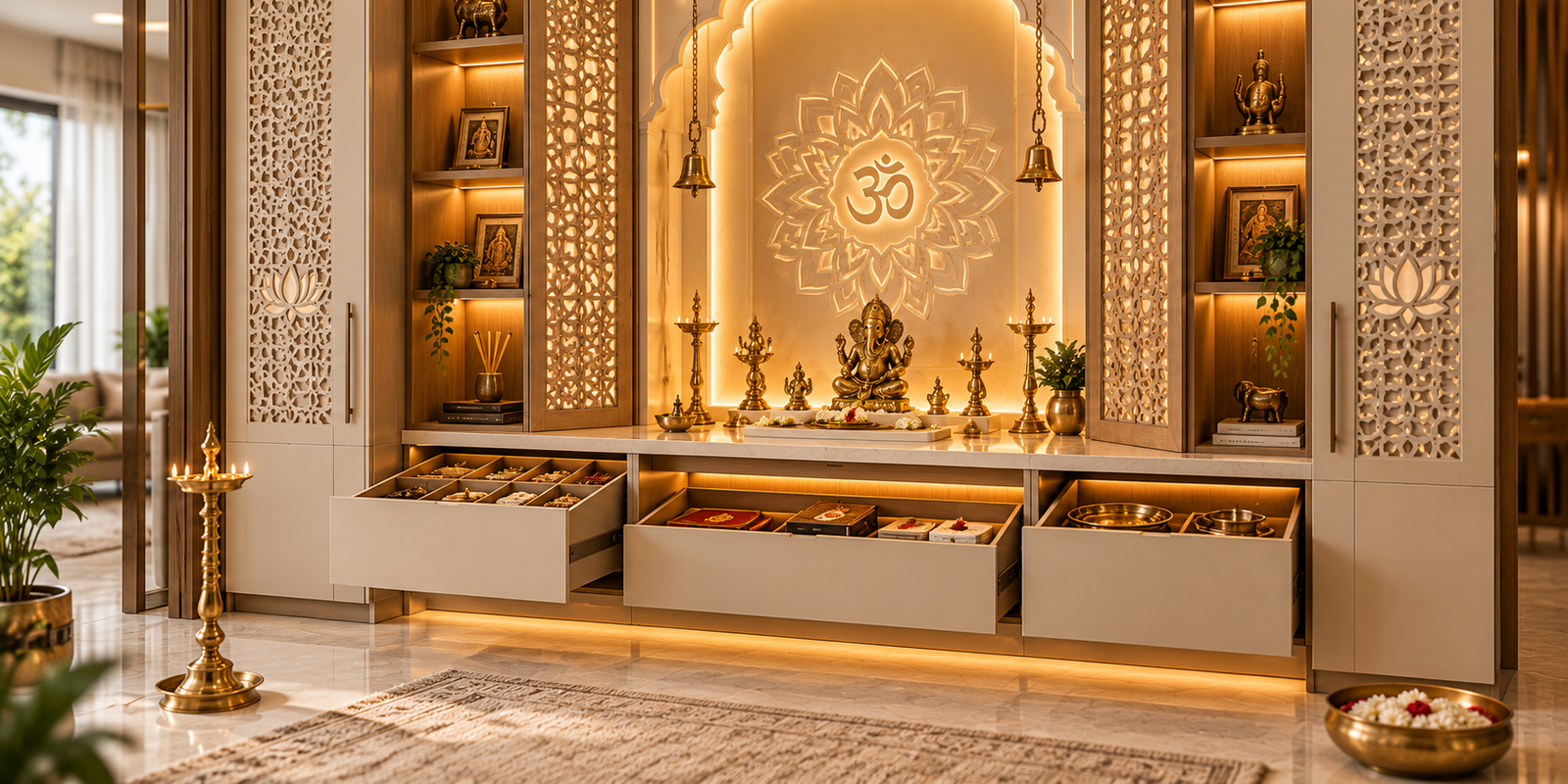
Introduction: Creating a Pooja Space That Balances Tradition and Modern Living
A pooja space holds a special place in many Indian homes. It provides a dedicated area for prayer, reflection, meditation, and religious observances, while often becoming one of the most thoughtfully designed corners of the interior.
Traditionally, household mandirs have been created using wood, stone, carved panels, and decorative architectural elements. Contemporary homes continue these traditions while incorporating modern materials, concealed storage, integrated lighting, and space-efficient layouts.
A well-planned pooja space should support the household’s rituals without becoming difficult to maintain. It should provide suitable room for idols or sacred images, prayer essentials, lamps, incense holders, offerings, and other items used during daily worship.
However, an attractive mandir is not necessarily a practical one. Insufficient storage can create clutter, unsuitable materials can be difficult to clean, and poorly planned lighting or electrical installations can introduce unnecessary safety concerns.
The most effective design considers the family’s customs, available space, maintenance requirements, and preferred aesthetic before decorative features are selected.
Whether you are creating a dedicated pooja room, incorporating a mandir into the living room, or designing a compact prayer niche in an apartment, understanding these principles can help you create a space that feels peaceful, organised, and suited to everyday rituals.
1. Choose the Right Location for Your Pooja Space
The location of a pooja space influences its privacy, accessibility, ventilation, and relationship with the rest of the home.
Before finalising the design, consider how the household uses the space and whether prayer activities require a quiet, dedicated environment.
Dedicated Pooja Room
A separate pooja room offers greater privacy and allows the design to incorporate specialised storage, decorative panels, lighting, and suitable space for prayer.
It may be appropriate in larger homes where a separate room can be allocated without compromising essential living areas.
The room should be easy to access and maintain. Consider the door opening, circulation space, ventilation, lighting, and the arrangement of the main prayer platform.
Pooja Niche in the Living Room
A dedicated niche can be a practical solution when a separate room is not available.
It can be integrated into a wall, a cabinet arrangement, or a carefully planned partition. This approach allows the mandir to remain distinct without requiring an additional room.
The main consideration is how the niche relates to everyday activity. Positioning it away from busy circulation paths can help create a calmer environment.
Pooja Unit Within a Multi-Purpose Space
Some apartments require the pooja area to share space with another room or an existing storage arrangement.
In such situations, a compact cabinet with a dedicated prayer platform and concealed storage may be suitable.
The design should clearly distinguish the prayer area from unrelated household storage. Adequate space should remain for placing offerings, arranging prayer essentials, and cleaning the unit.
Consider Privacy and Practical Access
The most suitable location depends on the family’s practices, available floor area, and daily routines.
Some households follow particular traditional or Vastu-based preferences when selecting a pooja location or orientation. These preferences can be incorporated into the design where practical, while ensuring that ventilation, electrical safety, and comfortable movement are not compromised.
The location should be decided before cabinetry, electrical points, and decorative panels are finalised.
2. Plan the Mandir Layout Around Your Rituals
The internal arrangement should reflect the way the family performs prayer and stores religious essentials.
Start by identifying the items that need to remain on the main platform and those that can be stored in drawers or cabinets.
These may include idols, framed images, prayer books, bells, diya lamps, incense holders, oil containers, flowers, offering plates, and pooja thalis.
Main Prayer Platform
The platform provides the principal surface for placing sacred images and arranging daily prayer essentials.
Its dimensions should reflect the number and size of the items used during worship. A platform that is too small can become crowded, while an oversized platform may consume valuable space in a compact home.
The surface should be stable, easy to clean, and suitable for the intended objects.
Lower Storage
Lower cabinets and drawers can accommodate spare prayer supplies, containers, cloths, and other items that do not need to remain visible.
The arrangement should allow the user to retrieve frequently used objects without repeatedly moving items on the prayer platform.
Upper Storage and Display
Shelves above or beside the main platform can accommodate selected decorative elements or additional sacred objects where appropriate.
Avoid overcrowding the display. Adequate spacing can make individual elements easier to appreciate and keep the mandir visually organised.
Space for Daily Rituals
The design should provide enough room for the activities that take place around the mandir, including placing offerings, lighting a lamp, and cleaning the surrounding surface.
Consider the reach required to access shelves and the clearance needed for doors or drawers to open comfortably.
A well-planned layout makes everyday rituals easier without relying on decorative complexity.
3. Choose Materials Suitable for a Pooja Space
The materials used in a mandir influence its appearance, durability, cleaning requirements, and suitability for the intended rituals.
Because pooja spaces may involve oil, flowers, incense, water, and occasionally open flames, material selection should consider more than visual appeal.
Wood and Wood-Inspired Finishes
Wood introduces warmth and can complement both traditional and contemporary interiors.
Suitable wood products and wood-inspired finishes can be used for cabinet structures, decorative panels, and storage units. Their performance depends on construction quality, edge treatment, finish specifications, and exposure to moisture or heat.
Keep combustible materials at a safe distance from open flames. Decorative wood panels should not be positioned where lamps or burning incense could expose them to heat or ignition.
Stone and Stone-Look Surfaces
Stone and suitable stone-look materials can provide a durable, visually substantial surface for a prayer platform or surrounding panels.
Selection should account for weight, installation requirements, stain resistance, cleaning, and compatibility with the supporting structure.
Some natural stones may require particular care or sealing, so follow the manufacturer’s or fabricator’s maintenance recommendations.
Laminates and Engineered Surfaces
Laminates provide a broad selection of colours and textures, including traditional wood-inspired patterns and contemporary neutral finishes.
They can be practical for cabinet shutters and storage units when the product is suitable for the application and correctly installed.
However, decorative surfaces should not be assumed to be heat-resistant or suitable for direct exposure to open flames.
Glass and Metallic Accents
Glass panels, brass-toned details, and selected metal elements can introduce elegance without requiring extensive carving.
Their placement should consider cleaning, fingerprints, structural support, and potential heat exposure.
A restrained material palette often creates a more harmonious appearance than combining many contrasting finishes in one small space.
4. Essential Divine Pooja Space Accessories for Better Organisation
Pooja accessories help maintain order while keeping frequently used ritual items accessible.
Their selection should reflect the household’s actual practices, the size of the mandir, and the amount of storage available.
The following eight features can help create a practical pooja space without sacrificing its traditional or contemporary character.
4.1 Pooja Storage Drawers: Keeping Daily Prayer Essentials Organised
Pooja storage drawers provide a designated place for prayer books, incense sticks, cotton wicks, matchboxes, small containers, cleaning cloths, and other everyday essentials.
Without dedicated storage, these items can accumulate around the main platform or become mixed together in general household drawers.
A well-planned arrangement separates items according to their purpose. One drawer may hold frequently used prayer supplies, while another can accommodate additional offerings or spare accessories.
Drawer dimensions should reflect the size and type of objects being stored. Shallow compartments are useful for small items, while deeper drawers may be needed for larger containers or folded cloths.
Select hardware that operates smoothly and is suitable for the expected load. The drawer should remain accessible without obstructing the surrounding space.
Material selection is especially important where oil, water, or other substances may be stored. Use suitable containers to prevent leaks and clean spills promptly.
Avoid storing lit lamps, hot utensils, or smouldering incense inside drawers. Open flames and hot objects should remain on suitable surfaces under appropriate supervision.
For households that perform daily rituals, organised storage reduces preparation time and makes it easier to return each item to its designated place after prayer.
4.2 Diya and Pooja Thali Storage: Protecting Ritual Essentials
Diya and pooja thali storage provides a dedicated location for lamps, offering plates, small bowls, and other utensils used during prayer.
These objects may be made from brass, copper, stainless steel, silver, or other materials, each with its own cleaning and care requirements.
A dedicated drawer or cabinet shelf helps keep the items together and prevents them from being mixed with unrelated household belongings.
Before planning the compartment, measure the largest thali and the height of any containers that will be stored upright. Sufficient clearance makes it easier to remove the items without scraping or damaging the surrounding surfaces.
Internal dividers can help separate smaller bowls, bells, and other accessories. A removable liner or tray may also simplify cleaning, provided it is suitable for the stored objects.
Make sure items are completely cool and any oil residue is safely managed before storing them. Lit diyas must never be placed inside enclosed storage.
For metal utensils, follow appropriate cleaning recommendations to avoid damage from unsuitable chemicals or abrasive materials.
This storage arrangement is particularly useful when the household uses multiple pooja accessories and wants to keep the main prayer platform uncluttered.
4.3 Open Display Shelves: Arranging Sacred Objects With Care
Open display shelves provide space for selected idols, framed images, religious books, decorative objects, and other items that the household wishes to keep visible.
They can introduce depth to the mandir and allow the arrangement to be adapted according to personal traditions.
Shelf dimensions should reflect the size and weight of the objects being displayed. Heavy items require suitable support, while fragile objects should be positioned where they are unlikely to be knocked over.
Spacing is important. Crowding the shelves can make individual objects difficult to see and can complicate cleaning.
Consider the height of each shelf in relation to how the objects will be accessed. Frequently handled items should remain within a comfortable reach, while higher shelves can be reserved for suitable decorative elements.
Open shelves require regular dusting, especially in homes where the kitchen is nearby or the space is exposed to outside air.
Lighting can help highlight selected details, but fixtures should be positioned to avoid excessive heat exposure or uncomfortable glare.
The arrangement should reflect the household’s customs rather than a rigid decorative formula. A simple, balanced display can be as effective as an elaborate one.
4.4 Bell and Hanging Accessories: Adding Traditional Details
Bells and hanging accessories can introduce traditional character into a pooja space while serving practical purposes during worship.
Depending on the design, they may be suspended from a suitable support, incorporated into a decorative panel, or positioned near the entrance of a dedicated mandir.
The support system must be strong enough for the weight of the hanging object and its expected movement.
Before installation, consider ceiling height, head clearance, door movement, and whether the bell can be used comfortably without striking nearby furniture or decorative elements.
Avoid hanging objects where they could fall onto a person or interfere with daily movement.
Material selection also affects appearance and maintenance. Metal accessories may develop patina over time, while decorative finishes can require specific cleaning methods.
The design should allow the bell and its supporting hardware to be inspected and cleaned when necessary.
Hanging accessories work best when their placement is coordinated with the mandir’s proportions and the household’s ritual practices.
4.5 Concealed Storage Cabinets: Maintaining a Clean and Peaceful Pooja Area
Concealed storage cabinets provide space for spare pooja supplies, additional vessels, cleaning materials, and other belongings that do not need to remain visible.
They can be particularly useful in compact homes where the prayer area must remain organised despite limited floor space.
The cabinet arrangement should separate ritual essentials from unrelated household storage. Items used frequently should be accessible without requiring the user to move decorative objects or rearrange the prayer platform.
Consider the cabinet’s depth, shelf spacing, door opening, and the size of the containers being stored.
Because pooja spaces may involve oils, water, flowers, and incense residue, surfaces should be easy to clean. Store liquids in secure containers and avoid placing them where leakage could damage the cabinet.
If the cabinet is close to an open flame, its materials and location require careful consideration. Combustible storage should remain separated from lamps and other heat sources.
Concealed cabinets are most effective when they reduce visual clutter without making frequently used items difficult to retrieve.
4.6 Decorative Back Panels: Creating a Distinctive Mandir Focal Point
A decorative back panel forms the visual backdrop of the pooja unit. It can establish the mandir’s character through colour, texture, pattern, and carefully selected ornamentation.
Design options include wood-inspired panels, stone-look surfaces, carved motifs, traditional patterns, and understated contemporary finishes.
Some households prefer a traditional architectural appearance, while others favour a minimal design with a simple backdrop and a small number of decorative details.
The panel’s dimensions should relate to the prayer platform and the surrounding wall. An excessively busy pattern can compete with the sacred objects, while an overly plain surface may not provide the intended visual distinction.
Material selection should consider cleaning, durability, installation requirements, and suitability for the surrounding environment.
If the design incorporates carved or perforated elements, ensure that dust can be removed without excessive effort.
Any decorative feature near a diya or other flame must be positioned with appropriate separation and made from materials suitable for the location.
Electrical wiring and mounting details should be planned before the panel is installed.
A well-designed backdrop creates a visual focus while allowing the prayer area itself to remain the central element.
4.7 Integrated LED Lighting: Creating a Calm and Well-Lit Prayer Space
Integrated LED lighting can highlight the mandir’s architecture and improve visibility around the prayer platform.
It may be installed along selected panel edges, within display niches, or beneath shelves, depending on the design.
Lighting should support the intended atmosphere without becoming excessively bright or distracting. Diffused illumination can create a softer appearance than exposed light sources.
Consider the relationship between general room lighting and the mandir’s accent lighting. The prayer area should remain visible and comfortable without appearing disconnected from the surrounding interior.
The colour temperature can influence the visual mood. Warm lighting often complements wood, brass-toned accents, and traditional decorative details, although the final choice should suit the materials and personal preference.
Before installation, plan the position of switches, power supplies, wiring routes, and maintenance access.
LED fixtures should be installed according to the manufacturer’s instructions and kept away from inappropriate heat or moisture exposure.
Integrated lighting is an optional design feature. A well-lit pooja space does not require elaborate illumination if simple, well-positioned lighting meets the household’s needs.
4.8 Jali and Traditional Details: Bringing Craftsmanship Into Modern Interiors
Jali detailing introduces patterned surfaces inspired by traditional Indian architectural screens and decorative craftsmanship.
These details can be incorporated into cabinet shutters, side panels, partitions, or selected decorative elements within a pooja unit.
Depending on the material and pattern, jali panels may add texture, create visual depth, or allow light to pass through selected areas.
The pattern should be proportionate to the size of the mandir. Intricate detailing can work well in a larger dedicated space, while a simpler motif may be more suitable for a compact apartment niche.
Consider the material, edge finishing, structural strength, and ease of cleaning. Intricate cut-outs can collect dust and may require more maintenance than a flat panel.
If a jali panel is intended to provide ventilation or partial visual separation, confirm that its construction supports that purpose rather than assuming every decorative perforation provides meaningful airflow.
Traditional detailing should also be coordinated with the rest of the home. Repeating a selected material, motif, or finish in a restrained way can help the mandir feel connected to the interior without overwhelming it.
The objective is to incorporate craftsmanship thoughtfully while maintaining a clean, practical prayer environment.
5. Plan Safe Lighting and Diya Placement
Lighting in a pooja space often combines electric illumination with traditional lamps. Each requires a different approach to safety and placement.
Electric Lighting
LED strips, recessed fixtures, and small accent lights can illuminate the prayer platform and decorative panels.
The electrical installation should follow the fixture manufacturer’s requirements, with suitable wiring, mounting, and access for maintenance.
Avoid placing fixtures where they could be exposed to oil spills, water, or excessive heat.
Diya Placement
Traditional diyas use an open flame and should be placed on a stable, non-combustible surface suitable for their use.
Keep flames away from curtains, flowers that may dry out, wooden panels, paper, decorative fabrics, and other combustible materials.
Maintain clear space above and around the lamp, and never leave an open flame unattended. Extinguish lamps safely after use and ensure that hot utensils have cooled before they are stored.
If the mandir includes a decorative canopy or enclosed niche, check that its design provides suitable clearance and does not expose nearby materials to unsafe heat.
Incense and Ventilation
Incense produces smoke and should be used in a space with suitable ventilation.
Avoid placing burning incense near combustible decorative elements or where ash can fall onto surfaces. Use an appropriate holder and allow the material to cool fully before disposal.
Electrical and Fire Safety
Do not allow electrical wiring to run where it may contact hot lamps, oil, or water. Electrical components and extension connections should be installed and maintained safely.
If the pooja area includes both decorative lighting and traditional lamps, their locations should be coordinated before the cabinetry and panels are manufactured.
6. Choose Colours and Finishes That Complement the Home
The appearance of a pooja space is influenced by its colours, textures, materials, and relationship with the surrounding interior.
Some households prefer traditional combinations of warm wood, brass-toned details, and decorative patterns. Others favour neutral surfaces, simple geometry, and subtle lighting.
Both approaches can work well when the design is proportionate to the available space.
Warm Wood Finishes
Wood-inspired surfaces can create a warm appearance and complement traditional or contemporary mandir designs.
The selected finish should be suitable for the intended application and should remain separated from unsafe heat exposure.
Light and Neutral Colours
Off-white, beige, cream, and other neutral shades can create a calm visual environment and work well in compact spaces.
They may also help a small niche feel more open, particularly when combined with appropriate lighting.
Stone-Look Finishes
Stone-inspired panels can provide a distinctive backdrop and complement metal accents or simple cabinetry.
Consider weight, installation requirements, and cleaning needs when selecting the material.
Decorative Metal Accents
Brass-toned and other metallic details can introduce traditional character through handles, borders, bells, or selected decorative elements.
Use these accents selectively so that the main prayer area remains visually balanced.
The most suitable palette is one that reflects the household’s preferences and coordinates with the surrounding home rather than following a single prescribed colour scheme.
7. Design a Compact Pooja Space for an Apartment
A dedicated prayer area does not always require a separate room. A carefully planned niche or compact cabinet can provide a practical solution in an apartment.
Start by identifying the minimum space required for the household’s usual prayer activities. The main platform, storage, and access should be planned before decorative features are added.
Vertical storage can accommodate selected items without increasing the footprint. Concealed drawers can keep smaller supplies organised, while a compact back panel can establish a distinct visual identity.
Avoid filling the niche with too many shelves or decorative elements. A simple arrangement can be easier to maintain and more comfortable to use.
The door and drawer mechanisms should not obstruct nearby furniture or circulation paths. If the unit is integrated into the living room, consider how its finish relates to the surrounding cabinetry.
Lighting can help define the prayer area, but it should be planned with suitable electrical access and maintenance provisions.
Ventilation is particularly important if incense or other smoke-producing ritual items are used.
A compact pooja space is most effective when it provides the essentials comfortably rather than attempting to reproduce every feature of a large dedicated room.
8. Common Pooja Space Design Mistakes to Avoid
Insufficient storage: Without dedicated compartments, prayer essentials can accumulate on the main platform.
Poor material selection: Decorative finishes may be unsuitable for moisture, oil, heat, or repeated cleaning.
Unsafe diya placement: Open flames should remain separated from combustible materials and should never be left unattended.
Excessive decoration: Too many contrasting finishes and display objects can make a small mandir feel crowded.
Inadequate lighting: Decorative illumination should not make the prayer platform difficult to see or maintain.
Ignoring ventilation: Incense and other smoke-producing items require appropriate ventilation.
Poor access to storage: Drawers and cabinets should open comfortably without interfering with the surrounding room.
Unplanned electrical work: Wiring, switches, and LED power supplies should be coordinated before installation.
Difficult-to-clean details: Intricate patterns and open shelves may require more frequent maintenance than expected.
Ignoring structural support: Heavy platforms, stone elements, mirrors, or suspended accessories must be securely supported.
Storing unsuitable items together: Keep ritual essentials organised and separate from unrelated household belongings.
Overlooking future maintenance: Lighting components, hardware, and cabinet surfaces should remain accessible for cleaning and servicing.
Planning these details early helps preserve both the appearance and practical usability of the pooja space.
9. How to Budget for a Pooja Space
The cost of a pooja unit depends on its dimensions, construction, materials, storage configuration, decorative detailing, lighting, and installation requirements.
A complete estimate may include the cabinet structure, prayer platform, drawers, concealed storage, decorative panels, jali detailing, electrical work, integrated lighting, and installation.
Additional work may be required for wall preparation, structural support, ventilation, or modifications to the surrounding interior.
Request a detailed quotation that specifies the materials, finishes, hardware, lighting components, decorative features, and installation inclusions.
Compare quotations on the same scope of work. A compact cabinet with a simple backdrop should not be compared directly with a dedicated pooja room that includes elaborate panels and integrated lighting.
Prioritise functional requirements first: suitable space for rituals, accessible storage, durable surfaces, safe lamp placement, and appropriate ventilation.
Decorative features can then be added according to the household’s preferences and budget.
A meaningful pooja space does not need to be elaborate or expensive. A thoughtful layout, comfortable access, and careful maintenance can be more important than the number of decorative elements.
10. A Checklist Before Finalising Your Pooja Space
Before approving the final design, review these points:
- Measure the available wall, floor, and ceiling space.
- Identify the location that best suits the household’s rituals and daily routines.
- Determine the size and arrangement of the main prayer platform.
- List the idols, images, utensils, and other items that need to be accommodated.
- Plan pooja storage drawers and concealed cabinets.
- Confirm the dimensions and accessibility of thali and diya storage.
- Select materials suitable for cleaning and the intended environment.
- Review the position of decorative panels and jali details.
- Plan LED lighting, switches, wiring, and maintenance access.
- Ensure safe separation between open flames and combustible materials.
- Provide appropriate ventilation if incense is used.
- Check the stability of shelves, platforms, and hanging accessories.
- Confirm that doors and drawers open without obstruction.
- Obtain a detailed quotation and warranty information.
- Review the final drawings before fabrication begins.
- Inspect finish quality, lighting, hardware, and installation before handover.
This checklist helps ensure that the mandir is practical, safe, and aligned with the household’s preferences.
Conclusion: Thoughtful Planning Creates a Meaningful Pooja Space
A well-designed pooja space combines practical storage, suitable materials, careful lighting, and details that reflect the household’s traditions.
Accessories such as pooja storage drawers, diya and pooja thali storage, open display shelves, bell and hanging provisions, concealed cabinets, decorative back panels, integrated LED lighting, and traditional jali details can improve organisation and visual appeal when selected appropriately.
The most important decisions begin with understanding the family’s rituals, the available space, and the practical requirements of daily worship. Accessible storage, easy-to-clean surfaces, suitable ventilation, and safe lamp placement establish a strong foundation for the design.
For homeowners creating a dedicated mandir or incorporating a prayer niche into a modern apartment, these considerations can help create a space that feels organised, peaceful, and connected to the home’s overall interior.
At Ocel Metallo, exploring pooja space design through these practical principles offers a useful starting point for understanding how thoughtful interior planning can accommodate traditional practices within contemporary homes.
Frequently Asked Questions
1. What should I consider when designing a pooja space?
Consider the available space, household rituals, platform dimensions, storage requirements, material selection, lighting, ventilation, and safe placement of lamps.
2. Can a pooja unit be designed in a small apartment?
Yes. A compact wall niche or dedicated cabinet can provide space for prayer essentials, provided it has appropriate storage, comfortable access, and suitable ventilation.
3. Which materials are suitable for a pooja unit?
Suitable wood products, engineered boards, laminates, stone, and selected metal or glass details may be used according to the application. Material choice should account for maintenance, structural support, moisture, and heat exposure.
4. How should I organise pooja accessories?
Use dedicated drawers and compartments for prayer books, lamps, thalis, incense supplies, and other essentials. Keep frequently used items accessible and return them to their designated places after use.
5. Is integrated LED lighting necessary for a mandir?
No. It is an optional feature that can improve visibility and highlight decorative details. Simple, appropriately positioned lighting may be sufficient for many homes.
6. How can I make a pooja space safer?
Place diyas on stable, non-combustible surfaces, maintain separation from combustible materials, provide suitable ventilation for incense, and ensure electrical components are installed safely.
7. How can I keep a pooja unit clean?
Choose easy-to-maintain surfaces, clean oil or water spills promptly, remove dust from decorative details, and store only cooled and safely prepared items in cabinets.
8. Should a pooja space match the rest of the home?
It does not need to use identical finishes, but coordinating selected colours, materials, and design details can help the mandir feel integrated with the home’s overall interior.